Hello readers! I am about to begin a new topical series of blog entries, this time focusing on excellent novellas that I think should be recognized as part of the Classic Literature canon. I have done two series in the past, one about Contemporary Lit and one about Apocalyptic Lit, and I have enjoyed categorizing literature in this way and hope you have too. So now I am about to begin a "Great Novellas" series for you all.
I want to talk about novellas and short stories because I'm afraid they may be somewhat overlooked in Classic Literature. Sometimes we view length as an accomplishment in literature in and of itself, which I think would be an unfair assumption. It is true that there are many long novels that are truly excellent, such as The Brothers Karamazov, Anna Karenina, and Les Miserables. But I do not think these are great simply for their numerous chapters; it is instead because the authors of each have clearly devoted considerable time and depth to each page. I could offer several counterexamples of very long books that I do not think are all that wonderful, but I will refrain at this time. My point is simply that just as we should not admire a book merely because it is long, so also we should not discredit a book just because it is quite short.
Furthermore, I think novellas may sometimes require even more talent than fully developed novels because the authors cannot waste a single word. Every piece of the story becomes absolutely essential, unlike several chapters that explain every individual aspect of a whale's anatomy and the minor details of manning a sperm boat. (Whoops, I may have let it slip after all...) My favorite quote to illustrate this comes from William Faulkner:
"I’m a failed poet. Maybe every novelist wants to write poetry first, finds he can’t, and then tries the short story, which is the most demanding form after poetry. And, failing at that, only then does he take up novel writing."
So let's take a cue from Faulkner and examine some of the amazing short stories and novellas in literature. I have already included a couple of novellas in my blog so far, but not with this special concentration. I recognize that a number of others before me have lauded short stories and novellas, and you have probably read a great deal of the ones I will mention. So feel free to suggest any novellas and short stories you love along the way!
Part One: The Yellow Wallpaper by Charlotte Perkins Gilman
Part Two: One Day in the Life of Ivan Denisovich by Alexander Solzhenitsyn
Part Three: Night by Elie Wiesel
Part Four: Ethan Frome by Edith Wharton
Part Five: Of Mice and Men by John Steinbeck
Part Six: Animal Farm by George Orwell

Tuesday, August 2, 2011

Thursday, July 28, 2011
Things Fall Apart
 Not too long ago, I was working for a textbook company and flipping through one of their enormous World Humanities books for review. I happened to wander onto a page about African literature and read some information about Things Fall Apart by Chinua Achebe. I think I reread the paragraph about him ten times because I couldn't believe I had never heard of him before! Achebe is generally considered to be the founding father of African novels, and he published Things Fall Apart, his first novel, in 1958. I was simultaneously impressed and saddened when I discovered this. Of course, I was eager to read the book that swept the world and garnered much-needed attention for African literature. However, 1958 seems extremely late for the first African novel, which makes me believe that we have either lost some African literature in history or the people have been extraordinarily stunted by various obstacles for a very long time. The African-American authors had achieved considerable success by then, including the highly popular Harlem Renaissance, and yet Africans were not being noticed. Thus, when Achebe finished his novel and sought publication, a lot of publishers did not take him seriously, either ridiculing the concept of an African novelist or dismissing it as lacking market value. Eight million copies later, I think we finally know better.
 I have not read a lot of African literature yet, but Things Fall Apart felt as though it thoroughly portrayed a genuine African culture throughout the entire story. There is no separation between the characters and the community, as they blend together in their traditions, superstitions, and relationships. To the Westerner, some of these things may seem a little crazy, but from the insider's perspective of the story, it becomes quite fascinating. When the white people come into the village and begin imposing on the cultural traits, I had somewhat mixed feelings. To be honest, I think there were some ways the white missionaries were making beneficial adjustments for the people. Some of the superstitions of the culture involved pain, murder, and unnecessary fear, which the missionaries were able to alleviate. However, there was also a strong sense of loss that came with some of these changes, as one culture imposed on the other.
Although there is undeniably a struggle between the Western and African cultures, this does not take up the majority of the story. The missionaries come into the village quite late in the novel, which I think is important to note. I don't think Achebe wrote the novel to illustrate injustices of the white people or tensions that existed. Instead, I think he wanted us to get a taste of the quintessential identity of Africans. Yes, the white people played a role in it, but I want to be careful not to concentrate too much on that aspect of the story. Instead, it is the various African characters who are most important.
The protagonist, Okonkwo, is an intriguing "hero." He has a number of faults, such as his pride in particular, and I cannot say that I admired him. However, I don't think that Achebe was trying to make us admire him but instead understand him. It is this distinction that made me love the book at the end. I spent most of the novel feeling unsure about it, but the ending was so perfectly done with such a powerful impact that I instantly embraced the whole book. I can think of a few other endings in literature that have likewise been so perfect that I instantly loved the whole novel, and it emphasizes to me just how important those last few paragraphs can be.
One of my favorite characters is Okonkwo's uncle, Uchendu. He embodies all of the respected characteristics of the culture but without the pride and temper of Okonkwo. He is an old man who has experienced a lot of pain and trials, but he lives with considerable wisdom and compassion. Okonkwo is forced to live with him during his exile from his homeland, and I think he was a key figure in the text, particularly during this time in Okonkwo's life.
There are many other characters who left an impression on me, including Okonkow's best friend Obierika, his dynamic daughter Ezinma, and the young tragic boy Ikemefuna. All of the various people in the story bring such wonderful color to the novel and fill the readers with a rich sense of African characterization. They are so different and individualized, it's fantastic.
Before I finish, I want to recommend that you read a post about African Literature by a guest on the Blue Bookcase. I read this while I had a draft of this post in my box, and I thought it was so interesting. She gives a wonderful overview of African literature to sample, with far more insight than I can offer. So check it out if any of this has intrigued you!
Monday, July 18, 2011
Forgive the Negativity...
I have resisted writing a post like this for a long time now, but I am giving into the temptation. Not too long ago, I read a funny post by Dead White Guys called "I hate your favorite book" in which she ranted about a couple of beloved classics. Although I do really love one of the books she mentioned, I still found the blog amusing and entertaining. I'm hoping that my entry will likewise entertain you and not aggravate you. Although I'm not exactly trying to copy what she did, I have had a burning desire to get this off my chest for a while now, so I'm taking her playful entry as a green light.
I have very consciously limited all of my reviews to books that I believe deserve to be designated as "Classic Literature." This has somewhat limited the amount of writing I can do because there are a considerable number of books that I regularly read which I do not think should be included in this list. I've noticed that a lot of bloggers follow the formula of summarizing and then giving their opinions, whether good or bad. There's nothing wrong with that, as it can be quite helpful, but I guess I've been trying to offer something a little different by picking up on one or two interesting issues within books that I love. But believe me, I do not love every book I read.
Ok, ok, enough procrastinating. Here goes... I really do not like Jane Austen. Whew. There it is. I have to admit that I have not read all of her novels, and I recognize that there is a possibility that I could change my mind if I did. But for now, I just have my feelings from reading two of them, and I am not a fan. The problem is that my favorite thing about novels is the psychological character development. I am fascinated by a multi-layered character who goes through struggles and accomplishments while moving toward the end of the novel. I love getting inside a character's head, and I want a plot that emphasizes that. Austen's characters are somewhat one-dimensional, and I can predict the ending by chapter two. I understand that her skill is in the use of language and wit, but it feels too frivolous to be a truly great novel for me. I'm sorry, Austen fans.
There have been a couple of novellas I read recently that disappointed me. For example, I felt let down by The Stranger by Albert Camus. I struggled to enjoy it in its complete lack of redemption and spirit. I also thought The Old Man and the Sea didn't have a lot to offer, which is unusual for Hemingway in my experience. Plus, I've seen it on a couple of "Best Books of All Time" lists, which surprises me. Oh, and this is old news, but I absolutely hated Melville's Billy Budd when I read it a while ago. That was brutal! (To be fair to Melville, I've read about two-thirds of Moby Dick and definitely find it to be a great improvement, though way too long-winded at times.) Now that I'm getting carried away, I may as well add that I really didn't like Jane Eyre the first time I read it either, but I was so young that I know I should probably try it again... I just don't particularly feel like it. I could also list a handful of contemporary novels I've read that disappointed me, but I'd rather not. And don't get me started on poetry...
Finally, there's an extremely important literary figure whom I do not particularly care for. This has always been my cardinal sin as a literature lover, and I am reluctant to talk about it quite as openly. But I will give you a significant hint and say he's the big "S." If you know who I am talking about and are infuriated, please know that I do not discount his contribution to literature and yet I have my reasons for my dislike.
That was actually more fun than I thought. I do apologize if you've taken any of this personally and can't believe my bad taste, but at the same time I don't feel too badly because I'm talking about some dead authors' writing, not about your mother. But after this, I promise I'll be better about biting my tongue again and keeping my negative opinions to myself... at least for a little while.
I have very consciously limited all of my reviews to books that I believe deserve to be designated as "Classic Literature." This has somewhat limited the amount of writing I can do because there are a considerable number of books that I regularly read which I do not think should be included in this list. I've noticed that a lot of bloggers follow the formula of summarizing and then giving their opinions, whether good or bad. There's nothing wrong with that, as it can be quite helpful, but I guess I've been trying to offer something a little different by picking up on one or two interesting issues within books that I love. But believe me, I do not love every book I read.
Ok, ok, enough procrastinating. Here goes... I really do not like Jane Austen. Whew. There it is. I have to admit that I have not read all of her novels, and I recognize that there is a possibility that I could change my mind if I did. But for now, I just have my feelings from reading two of them, and I am not a fan. The problem is that my favorite thing about novels is the psychological character development. I am fascinated by a multi-layered character who goes through struggles and accomplishments while moving toward the end of the novel. I love getting inside a character's head, and I want a plot that emphasizes that. Austen's characters are somewhat one-dimensional, and I can predict the ending by chapter two. I understand that her skill is in the use of language and wit, but it feels too frivolous to be a truly great novel for me. I'm sorry, Austen fans.
There have been a couple of novellas I read recently that disappointed me. For example, I felt let down by The Stranger by Albert Camus. I struggled to enjoy it in its complete lack of redemption and spirit. I also thought The Old Man and the Sea didn't have a lot to offer, which is unusual for Hemingway in my experience. Plus, I've seen it on a couple of "Best Books of All Time" lists, which surprises me. Oh, and this is old news, but I absolutely hated Melville's Billy Budd when I read it a while ago. That was brutal! (To be fair to Melville, I've read about two-thirds of Moby Dick and definitely find it to be a great improvement, though way too long-winded at times.) Now that I'm getting carried away, I may as well add that I really didn't like Jane Eyre the first time I read it either, but I was so young that I know I should probably try it again... I just don't particularly feel like it. I could also list a handful of contemporary novels I've read that disappointed me, but I'd rather not. And don't get me started on poetry...
Finally, there's an extremely important literary figure whom I do not particularly care for. This has always been my cardinal sin as a literature lover, and I am reluctant to talk about it quite as openly. But I will give you a significant hint and say he's the big "S." If you know who I am talking about and are infuriated, please know that I do not discount his contribution to literature and yet I have my reasons for my dislike.
That was actually more fun than I thought. I do apologize if you've taken any of this personally and can't believe my bad taste, but at the same time I don't feel too badly because I'm talking about some dead authors' writing, not about your mother. But after this, I promise I'll be better about biting my tongue again and keeping my negative opinions to myself... at least for a little while.
Thursday, July 14, 2011
Dubliners
As I was listing the authors I'd love to meet in my last post, I was surprised to realize that there were several I hadn't blogged about yet. One of these great literary figures is James Joyce. I am absolutely awed by the genius of Joyce. In college, I once wrote a very long essay in which I simply examined the intricate use of clothing in just two chapters of Ulysses. I was shocked by how much significance and symbolism I could find in such a small feature of this enormous work. Perhaps because of this, I have not yet plowed through Ulysses cover-to-cover, although I have picked through a number of chapters and found them quite intriguing. I want to take a moment and bow down before all of you reading this blog who have read Ulysses, (or Finnegans Wake, for that matter), thoroughly... You deserve much recognition!
 So instead of discussing Ulysses, which I hope to do someday down the road, I will talk about Dubliners. This is a short story cycle, but do not mistake its brevity for a lack of depth. In the beauty of a marvelously crafted short story cycle, each chapter is individually significant, but they all gain much greater value when read as a unit. The placement of the stories moves in a theme, gradually transitioning from young to old characters who experience some kind of epiphany moment. When I hear "epiphany," it has a positive connotation for me, as though a person has become enlightened about some personal strength or hope in life. However, each of these "moments of clarity" are clarifying for the character that his or her world is more sinister, disappointing, or hopeless than he or she once believed. Nevertheless, Joyce exposes these realizations quietly, without including moral comment or direct implications.
The true value of the stories is in the details. In these small literary portraits, Joyce includes a number of minute descriptions and observations which unlock the depth of the characters. Especially since the stories are short, I believe that there is not a word put in there unnecessarily and I try to carefully consider the meaning behind every remark. I think the image that most stands out in my mind is that of Eveline at the dock, watching her lover sail away but revealing little emotion. I'll also never be able to forget the scene at the end of "Counterparts," with the beaten son pleading for mercy.
Of course, I can't discuss Dubliners without mentioning Dublin. From what I understand, this short story cycle embodies true Irish nationalism, which is particularly clear in the story about Parnell and Ivy Day. Joyce is also known to have been extremely accurate in his geographical descriptions of Dublin. People have followed the descriptions of Dublin in his various books around town to confirm the exactness of his details. Yet this portrait of Dublin is not really all that picturesque, as it also includes much of what was gritty and dark about the city and its citizens. It's a raw, realistic portrait, and I absolutely love it for that.
There's a lot more to say, but I think this is a good start. So if you are intimidated by Joyce as I am, I encourage you to pick up a copy of Dubliners. It's wonderfully crafted and yet wonderfully accessible. I think it gives an excellent taste of Joyce's genius, and I hope to one day dive into one of his bigger works.
So instead of discussing Ulysses, which I hope to do someday down the road, I will talk about Dubliners. This is a short story cycle, but do not mistake its brevity for a lack of depth. In the beauty of a marvelously crafted short story cycle, each chapter is individually significant, but they all gain much greater value when read as a unit. The placement of the stories moves in a theme, gradually transitioning from young to old characters who experience some kind of epiphany moment. When I hear "epiphany," it has a positive connotation for me, as though a person has become enlightened about some personal strength or hope in life. However, each of these "moments of clarity" are clarifying for the character that his or her world is more sinister, disappointing, or hopeless than he or she once believed. Nevertheless, Joyce exposes these realizations quietly, without including moral comment or direct implications. The true value of the stories is in the details. In these small literary portraits, Joyce includes a number of minute descriptions and observations which unlock the depth of the characters. Especially since the stories are short, I believe that there is not a word put in there unnecessarily and I try to carefully consider the meaning behind every remark. I think the image that most stands out in my mind is that of Eveline at the dock, watching her lover sail away but revealing little emotion. I'll also never be able to forget the scene at the end of "Counterparts," with the beaten son pleading for mercy.
Of course, I can't discuss Dubliners without mentioning Dublin. From what I understand, this short story cycle embodies true Irish nationalism, which is particularly clear in the story about Parnell and Ivy Day. Joyce is also known to have been extremely accurate in his geographical descriptions of Dublin. People have followed the descriptions of Dublin in his various books around town to confirm the exactness of his details. Yet this portrait of Dublin is not really all that picturesque, as it also includes much of what was gritty and dark about the city and its citizens. It's a raw, realistic portrait, and I absolutely love it for that.
There's a lot more to say, but I think this is a good start. So if you are intimidated by Joyce as I am, I encourage you to pick up a copy of Dubliners. It's wonderfully crafted and yet wonderfully accessible. I think it gives an excellent taste of Joyce's genius, and I hope to one day dive into one of his bigger works.
Tuesday, July 12, 2011
Top Ten Tuesday: Authors to Meet
It's been quite a while since I last joined a literary blog hop, and I must say that I've missed them. It's so fun to play with an intriguing question for bibliophiles and see what everyone has to say. This week's "Top Ten" is a particularly fun question and one I've certainly considered before. It changes from time to time, but these are the Top Ten Authors I'm Dying to Meet:
1. Salmon Rushdie - His work is so fascinating and absolutely on the cutting edge of postmodern literature. I would just love to hear him lecture or even talk specifically about Midnight's Children. I'm sending him straight to the top of my list because he is still alive, and I would like to think that there's a miniscule chance he could come across this somehow and invite me to a lecture. It could happen...
2. Fyodor Dostoevsky - I know, I know; can't I pick someone else? Why is it always Dostoevsky? Because it just is. I am sorry for the repetition, and I considered leaving him from the list, but I find him absolutely fascinating and would love to have a personal encounter with that brilliant mind.
3. C.S. Lewis - In addition to loving Narnia as a child, I have grown to have such an enormous respect for this man. In many ways, I feel like he has mentored me over the years, and I would love to make that a personal mentorship, preferably back in Oxford over a couple of pints of British ale. Aaahhhh....
4. F. Scott Fitzgerald and/or Ernest Hemingway - I'm sure a lot of people are mentioning these guys, but for good reason. Not only are they wonderful authors of books I love, but they lived every writer's dream: they mingled in the cafes and bars in Paris with the most brilliant artists of their time, living as ex-pats and critics. So if we could meet, I would generously agree to meet them on their own turf.
5. Oscar Wilde - Oh man, how great would it be to sit down with Wilde? I would bring a notebook and pen to write down every witty remark he would effortlessly shoot off. I just imagine that our conversation would weave seamlessly between hearty laughter and serious discussion.
6. James Joyce - Maybe if I spent some time with Joyce, his brilliance would be so powerful that it would unavoidably sink into me a little bit. He had such an incredible wealth of literary knowledge and an inhuman ability to speak/write at a dozen levels at once. I would probably not understand half of our conversation until I was able to deconstruct it throughout the following week.
7. Mary Wollstonecraft - You know, this one is a little funny because I doubt I will actually write out my thoughts about her work, A Vindication of the Rights of Women, but she is a very influential author for me. Her work is not perfect, and I would have liked to see her push the issue even a bit further, but it was monumental for its time. She clearly had no lack of confidence or courage, and I am sure I would benefit from spending time with such a woman.
8. Aphra Behn - Speaking of strong women, I would love to sit down with Aphra during Restoration Theater. But unlike chatting with Wollstonecraft, Aphra would probably be bawdy and raucous and hilarious. She fearlessly set the stage for all female writers to follow and gave Dryden a run for his money. Oh, and did I mention that she was also a spy for the British government?
9. Nikolai Gogol - I have a strange feeling that a conversation with Gogol might be similar to one with Wilde. However, I picture Gogol with a much dryer sense of humor and perhaps a more direct critique of whatever is on his mind. I would especially like it if he could introduce me to some of his friends, but maybe that's cheating the fantasy a little bit.
10. Mark Twain - There's a lot of pressure on the last choice of the list, but I think Twain would be so fun to talk to. I think we could meet near the Mississippi River over a plate of crab legs, and I would soak in a million little stories and anecdotes from him. Sounds good to me!
You know, I was at dinner with a group of friends one time and we tossed around a somewhat similar question: "If gender didn't matter, which author would you marry?" It turns out that this is a much more difficult question because so many of my favorites were tortured artists with really screwed up personal lives. I'm still working on coming up with the best answer for that one...
1. Salmon Rushdie - His work is so fascinating and absolutely on the cutting edge of postmodern literature. I would just love to hear him lecture or even talk specifically about Midnight's Children. I'm sending him straight to the top of my list because he is still alive, and I would like to think that there's a miniscule chance he could come across this somehow and invite me to a lecture. It could happen...
2. Fyodor Dostoevsky - I know, I know; can't I pick someone else? Why is it always Dostoevsky? Because it just is. I am sorry for the repetition, and I considered leaving him from the list, but I find him absolutely fascinating and would love to have a personal encounter with that brilliant mind.
3. C.S. Lewis - In addition to loving Narnia as a child, I have grown to have such an enormous respect for this man. In many ways, I feel like he has mentored me over the years, and I would love to make that a personal mentorship, preferably back in Oxford over a couple of pints of British ale. Aaahhhh....
4. F. Scott Fitzgerald and/or Ernest Hemingway - I'm sure a lot of people are mentioning these guys, but for good reason. Not only are they wonderful authors of books I love, but they lived every writer's dream: they mingled in the cafes and bars in Paris with the most brilliant artists of their time, living as ex-pats and critics. So if we could meet, I would generously agree to meet them on their own turf.
5. Oscar Wilde - Oh man, how great would it be to sit down with Wilde? I would bring a notebook and pen to write down every witty remark he would effortlessly shoot off. I just imagine that our conversation would weave seamlessly between hearty laughter and serious discussion.
6. James Joyce - Maybe if I spent some time with Joyce, his brilliance would be so powerful that it would unavoidably sink into me a little bit. He had such an incredible wealth of literary knowledge and an inhuman ability to speak/write at a dozen levels at once. I would probably not understand half of our conversation until I was able to deconstruct it throughout the following week.
7. Mary Wollstonecraft - You know, this one is a little funny because I doubt I will actually write out my thoughts about her work, A Vindication of the Rights of Women, but she is a very influential author for me. Her work is not perfect, and I would have liked to see her push the issue even a bit further, but it was monumental for its time. She clearly had no lack of confidence or courage, and I am sure I would benefit from spending time with such a woman.
8. Aphra Behn - Speaking of strong women, I would love to sit down with Aphra during Restoration Theater. But unlike chatting with Wollstonecraft, Aphra would probably be bawdy and raucous and hilarious. She fearlessly set the stage for all female writers to follow and gave Dryden a run for his money. Oh, and did I mention that she was also a spy for the British government?
9. Nikolai Gogol - I have a strange feeling that a conversation with Gogol might be similar to one with Wilde. However, I picture Gogol with a much dryer sense of humor and perhaps a more direct critique of whatever is on his mind. I would especially like it if he could introduce me to some of his friends, but maybe that's cheating the fantasy a little bit.
10. Mark Twain - There's a lot of pressure on the last choice of the list, but I think Twain would be so fun to talk to. I think we could meet near the Mississippi River over a plate of crab legs, and I would soak in a million little stories and anecdotes from him. Sounds good to me!
You know, I was at dinner with a group of friends one time and we tossed around a somewhat similar question: "If gender didn't matter, which author would you marry?" It turns out that this is a much more difficult question because so many of my favorites were tortured artists with really screwed up personal lives. I'm still working on coming up with the best answer for that one...
Monday, July 11, 2011
"Fluff Lit," Take 2
Nearly a year ago, when I was just starting my blog, I wrote an entry about what I refer to as "fluff literature." I confessed that I sometimes take a break from classics and enjoy the light stuff. Although this is still somewhat true, I recently had a change of heart. One of my friends who was keeping up with my reading felt it was important for me to take a break and read something mindless. And boy was it mindless! I won't name the book because there's no need, but I found it to be so pointless that I didn't even enjoy it. In fact, I actually had a negative feeling in my gut and a strong sense of wasted time. However, I'm glad I had that experience because it really helped me appreciate just how much I love great literature. I was reminded that I'm not on this quest as a boast or a chore but because great literature makes me feel good in a way that nothing else can. Yes, it sometimes feels like work, and yes, it sometimes gets slow, but it satisfies a really hungry craving in me. When I'm finished, I feel like I've spent my time well and I've gained something from the observation or reflection. I often sense that I've connected with some literary genius who granted me permission to enter in his or her thoughts. Even if I didn't particularly like the book, I can usually recognize some of its strengths and set it aside with a fairly positive response. In my opinion, fluff literature cannot provide that and does not satisfy.
My previous example of "fluff" was Eat, Pray, Love, and I'm actually reading a somewhat similar book right now, called Without Reservations by Alice Steinbach. It follows a middle-aged woman who decides to leave everything behind and spend a year in various places throughout Europe. It has a much different writing style, with more thoughtful insights and less witty remarks, but it is difficult to miss the similarities. And once again, I am completely intrigued and interested because it appeals directly to my ever-present desire to travel. This time, however, I am not going to insist that reading these kinds of books from time to time is a healthy and necessary aspect of being a bookworm. One of the things I love about this blog is that it challenges me to write out my thoughts about each of the truly great books I read. When I do this, I almost always walk away from my computer screen with an even-greater admiration for the book than I had the day before. I just don't have that experience with the fluff I read. In fact, sometimes the only thing it really does for me is assure me that I am a quick reader despite the fact it took me over a month to read The Iliad or three months to piece together Les Miserables. (And I won't even confess to you how long I've been working on Moby Dick now...)
I guess my point is that I don't want anyone to think that one might "need a break" from Classic Literature. Although it may be slow and heavy at times, it is way more fulfilling than the dozens of fluff books you could have been reading in that same time. Mind you, I'm not swearing off light reading or scorning those who do feel the need for a break. Instead, I just want to suggest that perhaps we need a break from the fluff literature that fills up our mind without great substance and we need to replace it with the thick, meaty words of Dostoevsky, Woolf, and Hardy.
My previous example of "fluff" was Eat, Pray, Love, and I'm actually reading a somewhat similar book right now, called Without Reservations by Alice Steinbach. It follows a middle-aged woman who decides to leave everything behind and spend a year in various places throughout Europe. It has a much different writing style, with more thoughtful insights and less witty remarks, but it is difficult to miss the similarities. And once again, I am completely intrigued and interested because it appeals directly to my ever-present desire to travel. This time, however, I am not going to insist that reading these kinds of books from time to time is a healthy and necessary aspect of being a bookworm. One of the things I love about this blog is that it challenges me to write out my thoughts about each of the truly great books I read. When I do this, I almost always walk away from my computer screen with an even-greater admiration for the book than I had the day before. I just don't have that experience with the fluff I read. In fact, sometimes the only thing it really does for me is assure me that I am a quick reader despite the fact it took me over a month to read The Iliad or three months to piece together Les Miserables. (And I won't even confess to you how long I've been working on Moby Dick now...)
I guess my point is that I don't want anyone to think that one might "need a break" from Classic Literature. Although it may be slow and heavy at times, it is way more fulfilling than the dozens of fluff books you could have been reading in that same time. Mind you, I'm not swearing off light reading or scorning those who do feel the need for a break. Instead, I just want to suggest that perhaps we need a break from the fluff literature that fills up our mind without great substance and we need to replace it with the thick, meaty words of Dostoevsky, Woolf, and Hardy.
Wednesday, June 29, 2011
Jude the Obscure... I loved it!
I recently read my first Thomas Hardy book, Jude the Obscure, and I’m dying to discuss it. I think I had entirely the wrong impression about Hardy because I linked him with the other authors I know who were writing in his era. Yet when I did a little research about it, I learned that this book specifically received negative attention for being so different than the other literature of the time. It was banned from a number of places, and there’s even a rumor that a bishop publically burned a copy. Fortunately for Hardy, he was already a successful writer by this time and this was his last novel anyway.
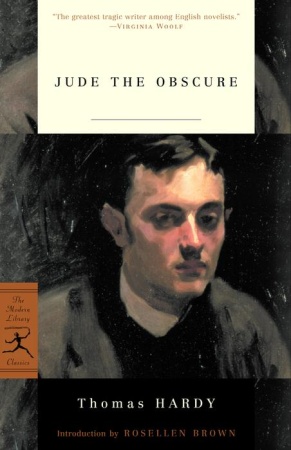 Let me just start by saying I loved it. I think the themes are fascinating and multi-dimensional, and the characters are so realistic it almost takes the romance right out of it. So what made Jude the Obscure so different and controversial? I think the most obvious reason for this reaction is its treatment of marriage. Hardy unapologetically exposes the non-romantic aspects of marriage that we usually don’t see in literature. Multiple characters are unhappy in their marriages, and some of them even acquire divorces, which was highly unusual at the time. In fact, the female lead character, Sue, proposes not only that couples can be in a happy relationship outside of marriage, but also that this is the only way to be truly content in a relationship. I imagine that this was a very revolutionary idea in 1895 when it was published. In fact, I think it’s still a little revolutionary today. I’m not sure I agree with her, but I can see that we still look at marriage as the primary way to demonstrate love and dedication in a relationship. In a number of ways, Sue is a strong female figure with intellectual and emotional insight, as well as the courage to challenge the culture’s mindset. However, my admiration for her eventually morphed into pity, but I don’t want to spoil anything for you so I’ll move on.
It’s interesting to me that I read Sons and Lovers and Jude the Obscure back-to-back because I think the character formation is similar. Jude and Sue are both flawed, although I tend to be very forgiving of Jude. (I happen to like him way better than Paul Morel). I should have known that anyone with the title “the Obscure” attached to him would be an appealing character for me, but I was surprised by the way I connected with him.
One of my absolute favorite things in the novel was Jude’s unbreakable attraction to the academic town of Christminster. It seemed obvious to me that Christminster was Hardy’s fictional name for Oxford, England, and he portrayed it incredibly well. I had the wonderful opportunity to live and study in Oxford for a year, and it did not take me two seconds to recognize that this was the town Hardy was subtly describing. The physical description of the buildings and streets was incredibly heart-warming to me as I remembered my time there. He so intricately expressed the indelible feeling you get in the city knowing that great academics lived and studied there before you. But part of what made Hardy’s description so accurate was the snobbery Jude encountered from the academics. In my experience, there is a very real division between those who live in the city as academics and those who live as blue-collar workers. The people of “Christminster” did not welcome Jude and his love of knowledge, and Jude eventually discovered the two different worlds that preside in this one historic city. Even though I was there as an academic, I even sensed some of those boundaries from my fellow students simply because I was American. Nevertheless, I have an enormous amount of love for the city of Oxford and feel as emotionally tied to it as Jude was.

But perhaps the gritty realism isn’t in the characters individually but instead in their interaction as a couple. The struggles and concerns of Jude and Sue throughout their relationship remove the “fantasy” aspect of their love story, and yet this is precisely why I found it to be believable. They face a number of obstacles, but they work through it together. And then, shockingly, tragedy strikes and challenges their relationship to the very core.
I was absolutely shocked by this tragic twist near the end. I honestly did not see it coming at all, although hindsight is 20/20, of course. In fact, as I was reading in public, I think I noticeably gasped and clasped my hand over my mouth. (Hmm, I should probably stop reading in public, because I’ve had other noticeable public reactions reading Lord of the Flies, A Hero of Our Time, and Captain Corelli’s Mandolin…) But seriously, this particular scene in Jude the Obscure really ripped my heart into pieces. It also completely changed the course of the novel.
I’ve already written so much, so I will stop myself from saying more. If you have read all this, I am so glad that you took the time. Clearly, I connected with this novel in a number of different ways, and I hope that this will inspire you to pick up a copy yourself or consider it from a different perspective if you have already read it. I do have a final question for any readers still looking at this. If you have read other Hardy novels, do you think that this is similar or considerably different? I wonder if Jude the Obscure was a bit unusual and I might be surprised in reading Hardy’s more popular works. Thanks for stopping by!
Subscribe to:
Posts (Atom)