Wednesday, October 31, 2012

Top Ten Tuesday: Literary Heroines

Alright, so it's not actually Tuesday today, but try to withhold your objections.  I was browsing my blogger feed just today when I saw that this week's Top Ten Tuesday by the Broke and the Bookish was about Literary Heroines.  Kimberly spouted off a list of "Kick Ass" heroines, and over 200 people have already participated in the Blog Hop!

Immediately, I wanted to join in this discussion.  This is actually a tough one for me, which bothers me on a number of levels.  I confess that most of my favorite literary figures are men and written by men.  The feminist in me balks at this, so I decided I needed to take the challenge and gather up my favorite fictional females.


OK, starting in reverse order with Number 10...

10. Katniss Everdeen in The Hunger Games

Katniss probably shows up in a large percentage of the blog hops for this one, so it's incredibly cliche for me to include her as well. However, I really do like her as a character so I'm jumping on the bandwagon.  I love that she's stubborn, independent, focused, and a major badass.  Plus, I like that she doesn't moon over the love triangle or over-analyze those relationships.  She's a great example for the YA readers.

9. Meg Murry in The Wrinkle in Time Series

Yet another YA choice, I decided to add Meg to my list.  She was definitely a literary hero to me back when I read these books.  She's smart, bookish, and awkward and yet manages to cross time continuums, save her family, and fall in love.  As a smart, bookish, awkward girl reading this, it was inspiring to me.

8. Scout Finch in To Kill a Mockingbird

Who doesn't love Scout?  She's curious and sweet, a little tomboy who loves her big brother.  She doesn't always understand what's happening, but she has a good heart and absorbs a lot of it.  We sort of get to experience her growing up, and there's an endearing juxtaposition of maturity and naiveté.

7. Francie Nolan in A Tree Grows in Brooklyn

I haven't written a review of this one yet, though I will do so soon.  It actually reminds me of To Kill a Mockingbird, for we follow a young girl's perspective.  But there is a lot more character development with Francie, and the story covers years of her life.


6. Holly Golightly in Breakfast at Tiffany's

First, I want to emphasize that I am referring to the Pulitzer Prize winning novella, not the movie.  Having said that, I also want to say that the movie is remarkably faithful to the original story and tells it beautifully.  Holly is so easy to love, for characters, readers, and movie-watchers.  She is quick-witted and flighty, and we see just a hint of the hurt and vulnerability underneath.  If you haven't read the novella yet, you really should.


5. Mariam in A Thousand Splendid Suns

I chose Mariam as my literary hero, but Laila is also worthy of being mentioned.  This book is remarkable for its relationship between two women who face intense suffering.  They are both married to the same abusive man, but it creates no jealous or bitterness between them.  Instead, they draw strength from one another, and their story is absolutely inspirational.

4. Mina Murray in Dracula

I doubt many people would pick her out of this story, but I loved her.  Mina really was a badass, particularly considering the era in which this was written - 1897.  Unlike Lucy, she is not the damsel in distress of the story.  She is actively involved in chasing Dracula, offering intelligent and brave participation.  She's like a 100-year precursor to Buffy.

3. Ethne Eustace in The Four Feathers

I feel like I've always lauded Ethne as one of my absolute favorite literary heroines.  I adore this book, and Ethne is a big part of the reason.  Although she acted rashly and pridefully at the beginning, she spends the rest of the novel in pursuit of redeeming herself.  She has extremely high standards for herself, but doesn't act like a martyr for it.  I think you have to read it to understand what I mean.

2. Isabel Archer in The Portrait of a Lady

I love Isabel!  She is admired for being intelligent, independent, and adventurous.  She is always hungry to learn and listens carefully to other people's perspectives.  Rather than following the path of her sisters, she strikes out on her own and embraces the uncertainty.  Even when her life takes an unexpected turn, she holds her head high and works through it.  I could read this book over and over again.

And the winner is...

1. Wife of Bath in The Canterbury Tales

I couldn't resist listing her as my favorite.  Keep in mind that this was written in the 14th century!  The Wife of Bath gets more attention than just about any other character.  She comments on other people's tales throughout the collection, but her own is one of the most memorable.  She's not bashful about her sexuality or her sense of humor.  I'm sure there are a number of feminist objections one can make, but I still like her and think she's pretty awesome.


Wednesday, October 17, 2012

October Reading

Dear Book Friends,

I absolutely love the fall.  I eagerly jump into the season by wearing jackets and sweaters, drinking apple cider, and eating all things pumpkin-flavored.  The trees are finally starting to change colors, and the air at its best smells like leaves and campfires.  I love the crispness of the wind on my cheeks when it starts to get cold, and I celebrate the little shivers down my spine.  I've already visited the apple orchard, walked through a corn maze, and brought home a pumpkin.  The mulling spices I bought are just begging to be made into mulled red wine.

So now I ask for your help...  I want to echo my love for the fall with my reading choices as well.  Last year, I decided to get into the spirit of October by reading a lot of famous spooky, eerie, and/or autumn-themed books.  I posted my reviews of them throughout the month and saw many of you doing similar reviews and read those as well.  I've noticed a recent surge of readership on these posts again this season, so I'm hoping you have been able to get into the spirit again and are checking them out.  Before then, I had never read these amazing books before, and I was pleasantly surprised that they were quality literature in addition to good October reads.  So I'm hoping you can help me continue the tradition and recommend some to try this year.

Here was last year's list:

Frankenstein by Mary Shelley

The Masque of the Red Death by Edgar Allan Poe

The Turn of the Screw by Henry James

Dracula by Bram Stoker

The Legend of Sleepy Hollow by Washington Irving


Now I know the month is nearly over, and I should have asked you sooner.  But I can always put them aside for next year, so don't hesitate to suggest something even if the month has passed.  Remember, they must be considered Classic Literature or worthy of such status, so please don't try to suggest Twilight or something.  *shudder*  (Yes, I am a book snob.  Don't act too surprised.)  However, I am not opposed to books written recently or ones that are obscure, so long as they are written well.  It doesn't have to be old or famous to be good.  It also doesn't have to have a Halloween theme, so long as it takes place in the fall.  A Room of One's Own, for example, has tons of references to October even though it isn't in narrative form.  So feel free to surprise me.

I hope to hear from you!  Happy October!!

Friday, October 12, 2012

A Room of One's Own

When I wrote my earlier post about Feminist Literary Analysis, I didn't have this book listed among my recommendations because I hadn't read it yet, and many of you were quick to point out the obvious hole it left.  But once I grabbed a copy, I absolutely loved it.  In fact, I've already read it twice.

A Room of One's Own is an elongated essay by Virginia Woolf, written in her characteristic stream-of-consciousness style.  She had been asked to discuss women and fiction, and her conclusion, in brief, was that each woman needs her own source of income and a room of her own in order to write freely.  Because she was writing in 1928, the obvious female examples who came to mind were Jane Austen, George Eliot, and the Bronte sisters.  These women had successfully produced fiction that society embraced and valued.  The 1920s had been boosted by the surge of the first wave of feminism, and Woolf took this opportunity to continue moving it forward.  Yet in order to do so, she studied the history of women and fiction, and she emphasized the need to be conscious of the tradition we have inherited.

Nestled in a library, Woolf researched the history of women and fiction.  Yet as she did so, it became clear that we have an unfilled heritage and are missing many potential heroes of our past.  Her famous example of Shakespeare's fictional sister stands out in our mind to represent centuries of women whose voices we will never get to hear.  So when she finally reaches Aphra Behn, I am filled with appreciation and longing to lay a flower beside her grave.  (I did try to do that once when I visited Westminster Abbey, but I couldn't find it!  I am still kicking myself for not searching longer, and I hope to go back someday to fulfill this mission.)

I have read several of Woolf's novels in her stream-of-consciousness style, but I think this essay is my favorite use of it.  We feel as though we are working through every thought with her and experiencing her discoveries, surprises, and realizations in real time alongside her.  She gets distracted and side-tracked at moments, but the whole piece blends together as one continuous thought.  The chapter breaks seem unnecessary and out of place, as though the thought process should not be broken or stopped.  It made me read the book very quickly each time I read it because I felt carried by the wave of her words.  This time, it was especially fun to read it in October because of her description of this season in her writing as well.

I think that one of the most remarkable things about this book is its tone.  There is no trace of anger or bitterness when she discusses women's past oppression, and she does not indicate that men must be pushed down in order for women to surge forward.  At times, she certainly evinces some hurt caused by men and the way they have treated women.  But she states:

"I need not hate any man; he cannot hurt me.  I need not flatter any man; he has nothing to give me.  So imperceptibly, I found myself adopting a new attitude towards the other half of the human race.  It was absurd to blame any class or any sex, as a whole.  Great bodies of people are never responsible for what they do.  They are driven by instincts which are not within their control."

Repeatedly, Woolf says that anger against men and their poor treatment of women is yet another obstacle in the progression of the female race.  Good writing is marred by traces of bitterness and contempt.  She praises the four famous novelists specifically for "writing without hate, without bitterness, without fear, without protest, without preaching."  She insists that every woman must write for herself, not in reaction to others or in order to make them feel a certain way.  The best writing is based on truth and honest feelings without hidden (or obvious) agendas.

Now, I have to add a small footnote and say that I do not agree with everything Woolf says in this book.  The last chapter in particular contains some theories I do not fully support, dichotomizing things as masculine and feminine in perhaps an unhealthy light.  However, Woolf was far ahead of her time and made great strides for the feminist movement, so I do not criticize her at all.  Many leaders in the third wave of feminism have since picked up this idea and pursued its implications, and Woolf helped us get to this place.

And so, I will end my post with Woolf's wise words.  She has an amazing sense of humility underneath her brilliant wisdom and advice.  I can easily start believing that I know good literature apart from bad literature, and this blog is my soapbox to preach my taste.  But I want to keep in mind that reading is an individual experience, despite all the ways we can form community around it.  And I'll let Woolf have the last word this time.

"Here I would stop, but the pressure of convention decrees that every speech must end with a peroration.  And a peroration addressed to women should have something particularly exalting and ennobling about it... I find myself saying briefly and prosaically that it is much more important to be oneself than anything else.  Do not dream of influencing people... Think of things in themselves."

Tuesday, October 9, 2012

The Fountainhead

This is the reason I had to restart my blog.  This is the book that demanded conversation.  In fact, I am writing this within minutes of reading the last line, desperate to prolong the experience and allow it to set its roots in me.

Reading Anthem as your only book by Ayn Rand is a crime to literature, a crime that I was guilty of for quite some time.  As you can probably tell from my blog, I like to sample literature like a buffet, tasting just a little bit from a wide selection of different authors and periods.  In many cases, I've read only one piece by an author before moving on to someone else.  But although Anthem is an interesting novella, it does not even begin to do justice to Ayn Rand.  She is absolutely brilliant, and the way she carefully crafts and unfolds a long story is almost breathtaking.

I cannot bring myself to give you a plot synopsis for The Fountainhead because it doesn't even begin to capture what the story is truly about.  If you absolutely need to know, I'm sure you can find one online somewhere.  To be honest, I didn't have much interest in reading this book at the beginning.  I had heard so much about Rand's philosophy and politics that I thought it would make for a dry and serious novel.  But now I am kicking myself for avoiding this book as long as I did.

Nearly halfway through the novel, I wondered why everyone emphasized her philosophy so much and yet I had heard nothing about the plot.  I felt that it was a story about architecture and unique characters, with the philosophy running merely as an undercurrent.  Now that I have finished the novel, I understand how everyone seems to forget that.  I acquiesce that every page mentions some form of the word "architecture" or "building."  The descriptions are dripping with succulent care.  There's a love and brilliance in the presentation of the buildings, and the man who is Howard Roark.  But by the end of the novel, one recognizes that it is not about these things.

Ayn Rand is the Howard Roark of literature.  She was a genius in her craft and clearly had a clear vision for what she meant to convey.  However, this book has received its fair share of controversy, and I can hear the objections ringing in my mind - that it's long, that it's indecent, that it's unrealistic, that it's pretentious, that it's boring.  Even though I absolutely love this book, I will not recommend it to friends as freely as I do with others, and yet I quiver at these objections.

So what is it that makes this book so great?  Why does it stand immortally in the shelves of Classic Literature?  I believe she offers a voice that is not heard in other pages.  Truthfully, I do not fully agree with her feelings about individualism and collectivism, but it doesn't matter.  I still benefit from hearing her perspective, and I feel like a stronger person because of it.

Only great literature can make you feel like a better person for having taken the time to read it.  There are a few books that have done this to me before.  Crime and Punishment, Invisible Man and East of Eden immediately stand out in my mind as works that have made a lasting impression on me and deeply fed a need.  But I have spent this past year being torn down by a number of unforeseen obstacles and curveballs.  I have been broken and lost and aimless.  I have pushed through pain and fought to maintain a healthy and positive attitude.  I have started rebuilding myself from the rubble of this past year, and The Fountainhead pushes me to make this new version more wholly me than any model of the past.

In my opinion, the most interesting concept in The Fountainhead is a redefinition of the words "selfish" and "selfless."  Immediately, a swarm of associations come to mind with those words.  But Rand defines "selfless" literally, as the lack of a sense of self.  Selfless people are the ones who have built their identities on what they believe other people desire and admire.  If pressed, they probably could not identify any of their choices as ones which truly came from their own desires.  I understand this concept because I have lived it.  Selfish people, on the other hand, know exactly who they are, and nothing could make them change it.  There is nothing so valuable to them that they would compromise who they are and what they believe.  Not public opinion, not personal comfort, not great success.  Howard Roark is the embodiment of this kind of selfish person, and it is fascinating to watch him wage war with the rest of society.

Interestingly, I don't love this "hero" of the story.  I would venture to say that Rand didn't even want readers to love him.  But I do admire and respect him.

Finally, I can't help but note that one of the most surprising things I discovered in this novel is that it is romantic at its heart.  By no means is it romantic in the most common sense of the word, but there is a powerful, underlying theme that there is someone for everyone.  The key relationship is strange, insensitive, and unnerving, but they fit as though they were built to be together.  There's something so romantic in the unexpected aspect of this, and I'm afraid that often gets lost in the typical discussion of this book.

If you have read my entire post, thank you for taking the time to listen.  I welcome your thoughts in the comments below. 

Saturday, October 6, 2012

Time to Come Back!

I would like to return to the world of blogging.  It has been quite a few months since my last post, and I have missed it.  This past year has quite possibly been the most difficult one I have ever faced.  In March, I shared with you my grief over the loss of my father.  But the hits just kept coming, and I could never have imagined the curveballs I experienced even after that. I reached a place of discouragement, and I was hardly even reading anymore, let alone writing about it.  However, I have slowly risen from the ashes and moved forward.  I feel that I am in a better place now than I have been for a year, and I do not take that for granted.  And part of coming back to being myself is coming back to this blog.

Writing this blog has been an unexpected joy for me.  I started with very low expectations and wasn't feeling too strongly that I would have something to say.  But with time, I came to depend on this blog as my connection to stimulating thought and conversation in an otherwise monotonous routine.  I found that the blog kept me accountable to continue reading good literature and expressing my thoughts about it.  I discovered that it filled a big part of the void created after I left college and all those delightful literature classes.  Significantly, I started to write the blog solely for myself.

Don't misunderstand me; the responses from those of you who read this blog were a big part of the unexpected joy.  Many of you made book recommendations for me based on my entries, and I found some amazing pieces of literature through you.  You also pushed me to think about the books I had read in a new way, and you pushed me to keep reading and keep writing.

Likewise, I greatly enjoyed reading many of your blogs as well.  I was amazed to discover this huge blogosphere of book lovers.  I started to view some of you as my friends, even though we had never met.  I am eager to get back into the habit of checking out your thoughts and joining your blog hops.

When I read a good book now, I crave a way to express and share it.  Not all of my friends are interested in talking about books, and I often have to keep my mouth shut.  But I believe that books are meant to be shared, and you can learn much more in doing so.  I am so humbled to have an audience who is actually interested in what I have to say!

So I am going to try to come back, though I don't know how frequently I will be able to post.  But there are several books I'm itching to share, and I'm also ready to hear some new suggestions.  If anyone is reading this, thank you.  I know that I may have lost some readers in this time away, but I want to press forward again anyway because I know it is good for me, whether I have readers or not.

Wednesday, April 11, 2012

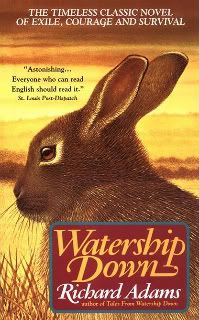
Watership Down

I often have some preconceived ideas about books before I read them, especially since I almost exclusively read classics or suggestions from friends.  But I think that I have never been more wrong than I was with Watership Down by Richard Adams.  Before I read the book, I had only heard people's reactions to it and not a summary of it.  One of my friends told me that she was completely entranced and swept up in the story.  Another friend told me that it had tremendous symbolic implications, including deep religious insight.  Another friend indicated that it was an exciting adventure story with a plot that moved along quickly.  And the title itself - Watership Down - sounded ominous and full of heavy implications to me.  So what is it?  Well, it is the journey of a group of rabbits, written from their perspective.  That was not what I expected.  But were my friends wrong?  No, I think they were right on target.

In a way, I am reminded of Lord of the Flies when I think of this book because it is another story that appears to contain children's content but is not written for children.  This is not the Velveteen Rabbit or the Peter Rabbit stories.  Each of the rabbits in this story have depth in their character, and they represent a variety of viewpoints.  After a dangerous encounter, Adams sums it up well: "There was no more questioning of Bigwig's strength, Fiver's insight, Blackberry's wits, or Hazel's authority."  Again, each of these traits is very important to the characters and plays a critical role in the story.  I think it's especially meaningful that the characteristics are divided up among several rabbits and not devoted to one all-powerful leader.  Yet although the characters are enjoyable, I don't think that adequately explains why adults like the story so much.  We can feel strongly about characters without praising the story quite so highly.  So why do we love Watership Down?  Why do we get hooked into their story?

A significant aspect of the novel's depth exists because Adams was very thorough when he created the world of these rabbits.  He established a history for the warren, a language unique to the rabbits, and a number of mythological stories shared in the rabbit culture.  The hero of these stories, El-ahrairah, is an interesting piece of the story and should not be overlooked.  The rabbits have a deep connection to these stories, and they listen with their whole hearts.  The legendary stories provide them with courage, humility, and loyalty when they need it most.  I think that's the underlying message of Watership Down in general: a story can move us.  We are inspired by rabbits, the most meek and quiet creatures, and we can get attached to their story.  Even fictional stories hold great power, for they can often be the best way for listeners to really hear wisdom and truth.

Moreover, the implications of this story go far beyond the novel itself.  Thus, I was surprised to read Adams write in his introduction: "I want to emphasize that Watership Down was never intended to be some sort of allegory or parable.  It is simply the story about rabbits made up and told in the car."  Yet whether he meant to do it or not, the story contains powerful symbolism that has fascinating connections to various philosophies, theologies, and components of pop culture.  Renowned theologian Stanley Hauerwas has extensively studied Watership Down for its reflection on the Christian life.  Often comparing it to Animal Farm, many read it as a political allegory that exemplifies the problems of leadership made of pride, over-indulgence, and totalitarianism.  The brilliant TV show Lost references the book multiple times, and there are some fascinating comparisons and clear influences from it.  When I read about District 13 in Mockingjay, it immediately reminded me of Efrafa, the underground community whose inhabitants are given strict schedules and heavy limitations for their own "protection."  I could go on with many more examples, but I don't want to overdo it.  I am simply amazed by how many people are drawn to this story and connect with it on so many different levels, especially since Adams never intended for it to be more than a good rabbit story.  I believe that it has deeply embedded itself in popular culture, but I don't think we are fully aware of it.

I think that Watership Down exemplifies the power of great literature.  Somehow the work itself has far exceeded the author's ambitions for it and impacted people on a grand scale.  This story seems so unlikely to hold such great influence, but I believe in the power of narrative.  Even though the plot is about a group of rabbits who face trials and start their own warren, we connect with it.  We may not have to fight off cats and foxes, but we have our own challenges.  And we must reflect on our own race when we witness the terror that man can bring.  Watership Down is one of the most unlikely classics, and yet I think that is precisely why it makes for an extraordinary piece of Classic Literature.

Friday, April 6, 2012

The Hunger Games Trilogy

I know this is supposed to be a Classic Literature blog, but I have to write about the Hunger Games trilogy for a moment.  I just read them... No, let me rephrase: I just devoured them.  In general, I like to savor things.  If I love something, I want to make it last as long as possible.  I don't want to read all of the books from my favorite authors at once because I like to save some for later.  I don't want to watch a TV series straight through when I could instead drag it out.  I eat my dessert slower than all of my friends and drive them crazy.  But with the Hunger Games, I swallowed them whole in just a few days.

I think there are a number of reasons I had this reaction.  First of all, it is an engaging story, and I don't think anyone can deny that.  It's action-packed, and it's easy to fly through the pages to find out what will happen.  I genuinely did get caught up in the story and could feel myself rooting for Katniss.  However, I think I read them so quickly because I so rarely read YA literature.  In fact, I can't even remember the last time I read something this light and easy.  Not even my "fluff" literature can be read this quickly.  Half of the temptation for me was the knowledge that I could finish the whole thing in a day if I wanted to.  I never read books in a single day anymore!

Regarding its literary merit, I'm not quite as enthused.  Although I was greatly wrapped up in the story, I did notice some cracks and places that could have used some added depth.  For example, there were a few plot lines that felt shallow, and the Panem history could have certainly benefited from more detail.  However, I don't hold these things against Suzanne Collins because I don't think that's the purpose of the books.  The purpose is to engage young adults and get them excited about reading, and I think she successfully accomplished it.  If it doesn't rank well in literary scholarship, that's not a problem.  She created some characters we can truly root for and attach ourselves to.  Moreover, I think she created great role models for young adults, and I was thoroughly impressed with the way she presented the "love triangle" as merely a small part of the story and not at all the focus of it.  I think it's good for young readers to see that Katniss was way more focused on surviving and protecting those she loved than getting wrapped up in young romance.  But, of course, a young romance is practically necessary for YA literature, and I forgive the trilogy for its shallow moments.

I also like dystopian literature in general.  I wrote a short series I called "Apocalyptic Literature" you can find in my "Serial Posts" tab, and I focused pieces that contain a bit more depth.  But in the Hunger Games, I enjoyed that dimension of the story, and I am impressed with Collins' creativity in crafting it.  I don't think I could ever come up with some of the scenarios she invented.  Again, I want to only judge the trilogy for what it is, and I think it fully succeeded in its genre.  Will I add it to my list of Classics?  Well, no.  But did I enjoy reading it?  Absolutely.

Finally, I'm grateful to this fun YA trilogy because it reminded me how much I love to read.  I have to admit that I've been bogged down lately and unable to get excited about reading.  A lot of things have changed in my life in the last several months, and somehow I lost some of my reading energy.  But as I pictured this story in my head and eagerly followed Katniss' journey, I remembered that books are such a wonderful source of entertainment.  The feeling you get when you read a good book cannot be replaced by any other activity.  My mind just lights up in its imagination, and my fingers tear through the pages to eat up whatever is coming.  And when it's done with depth and sincerity in those really phenomenal Classic Literature novels, it makes me feel stronger and wiser at the end.  Yeah, I love that, and I'm ready to dive back in.