Monday, March 11, 2013

Life of Pi

I've been torn about whether or not to promote this book ever since I first read it, and the current movie version has now pushed me over the edge.  I originally thought I might add this to my "Contemporary Lit" series since it was published in 2001.  However, I've been wrestling with whether it really contains the depth I require in order to assert that a book ought to have "Classic Literature" status.  Yes, I realize that I am being too hard on myself and my guidelines.  If I like a book, I should just write about it, shouldn't I?

Well, no.  If I want to be true to my original intention for this blog, it was to advocate for great literature.  The literature I have written about is the literature which has most shaped me, moved me, challenged me, and impacted me.  I have read every page of these books, and I believe they are largely responsible for forming who I am.  Some of them were a struggle and others were a breeze; all of them were intensely satisfying.  I write about these books because I want you to read them too.  I want you to grow in your desire to invest in truly great literature and not just the flippantly entertaining pieces.

Now here I am, writing about Life of Pi by Yann Martel.  If it weren't for the last few pages, I don't think I would be doing this.  The entire novel is an enjoyable read, and I don't want to negate the value of reading simply for pleasure.  I'm not quite so pretentious that I scorn such books or never indulge in them myself.  Yet in order for me to write about it on my blog, I needed it to be more.  And the twist at the end made me realize that it really was.

I don't think I can talk about this without slipping some spoilers, so *please stop reading* if you don't want to ruin something for yourself.  I usually avoid spoilers, but this ending is so critical for understanding the depth of the story that I cannot neglect it in my discussion.  For the majority of the novel, we are taken on a journey of magical realism and fantasy, as a young boy is stranded at sea with wild animals from his family's zoo.  In particular, we read about Richard Parker, the regal Bengal tiger which Ang Lee's movie amazingly brings to life.*  We learn that Richard Parker is neither tame nor vicious, and Pi spends months trying to connect with this animal passenger who unexpectedly joined him.  Yet most of all, this story is about survival against enormous odds as Pi and Richard Parker float in the Pacific Ocean for 227 days.

In the final chapters, two Japanese colleagues visit Pi in the hospital in order to investigate the cause of the shipwreck.  They listen to Pi's story and submit a report to the Maritime Department.  After telling them all about Richard Parker and the story we just read, Pi eventually gives them a second story, which has a number of obvious parallels.  This second story is far more tragic than the first; it's heart-wrenching and gory and shocking.  It changes everything.  Suddenly, the whole story takes on new meaning and interpretation, and it's tempting to immediately re-read the book in order to fully appreciate that.

I think that my favorite thing about this novel is that it illustrates the power of story.  I have long believed that there is a power in narrative and fiction, and that it can teach us things we wouldn't truly be able to understand otherwise.  It opens doors to our hearts and minds and allows us to access feelings and messages that we need to receive.  Martel beautifully reveals this with a compelling force of imagination and deeper meaning.

So at first, I felt that this was an adventure story but not necessarily a truly great work.  But I am challenged by Pi's words at the end:

"I know what you want. You want a story that won't surprise you. That will confirm what you already know. That won't make you see higher or further or differently. You want a flat story. An immobile story. You want dry, yeastless factuality."

Perhaps that is what I wanted, and perhaps I nearly missed the greater story.  Perhaps my stubborn attachment to Classic Literature is inadvertently blocking me from some wonderfully imaginative pieces.  And you know what?  Life of Pi is a marvelous novel, fully deserving of its acclaim.

*Ang Lee's recent movie is a true masterpiece of cinematography.  Moreover, it is extremely faithful to the book and an excellent representation of the original novel.  I definitely recommend it!

Sunday, March 3, 2013

Guest Blog: Jane Austen Overview

Thus far, I've only had one guest blogger on my site, but I want to bring this back and share some new perspectives.  So now I will turn it over to my good friend, Abigail Solberg...


“It is a truth universally acknowledged that a wealthy man must be in want of a wife.”

Ah, the sentence that almost everyone who has ever visited a library or cracked open a book has heard once before.  I mean, honestly, I didn’t even have to look at the book to make sure I got it accurately.  As you can probably already deduce, this is not Amy writing. There will be too few intelligent words and many more (failed?) attempts at wittiness than what you've grown to know and love about Amy's blog. Sorry, hate to disappoint, but I'm not Amy. I didn't graduate after studying in the Oxford library, just a few dark-wood-tables-and-massive-aisles-with-ladders-and-books away from Anna Popplewell.

This is Abi, and this is what I believe to be one of Amy’s first guest blog posts! If you like what you read, you can try to follow me on my blog, The Abi Complex, but seeing as I haven't written in as many months as Paula Deen denied having T2 Diabetes, it might be a waste of time to sign up. But feel free to check it out!

As for how Amy and I know each other, that is a story that dates back nearly 6 years! It all started in the summer of ’07 when I got an e-mail while I was in Romania from some Indiana girl claiming to be my freshman roommate. She told me that her colors for her side of the room were blue and brown, AND (since picking the colors of your room seemed to me to be the most important part of preparing for college), I safely assumed that I would not like her.

What I learned within the first month of school was that me and my pink comforter would find her to be one of my closest friends through all four years. We would watch football together, talk about classes and guys, debate over movie choices, drink coffee AND talk about literature. I found Amy to be one of the only people who could excite me about reading a book! The passion that would fly across her face as she swore to me that I would love some book made me so excited to read it. We started a tradition, where every holiday we would give each other a new book to read that we had already read and loved.

Thanks to Amy, I have been exposed to The Bell Jar, The Four Feathers, Captain Corelli’s Mandolin, Moby Dick, and more.

Unfortunately for her, my selections have been on the girly side. Because I knew that she liked Uncle Tom's Cabin, I thought for some reason that the perfect first book to give her would be Mansfield Park by Jane Austen… because the movie version (which I'd seen more recently than reading the book) included a side story about the father mistreating his African slaves. Unfortunately, that is not in the book, and was probably the WORST book to give her to introduce her to Jane Austen.

Epic. Fail.

This is the one author that Amy and I have constantly disagreed on: “Jane Austin never writes about anything important. It’s just a bunch of lazy conversations that don’t amount to much of anything.” This is not a direct quote from her, but it is the reader’s digest version of our many conversations on the topic. So, because I will most likely not be able to post about this author again on her site, I will comment on Austen’s work as a whole, rather than one specific book - trying to spit out everything that I can before Amy catches on and kicks me out!

So let’s leave that lengthy introduction and get to the best part: Jane Austen.

Let’s think about this for a moment. What other author has had all of his or her works turned into movies, has had a film made about her life AND a film about a book club based on reading her works?! There is just no way that anyone can deny the impact she has had on the world.

I firmly believe that any woman who meets the following qualifications will benefit/enjoy reading one or all of Austen’s novels:

1. If you think you would like the Bronte sisters’ books better if they were just a touch happier.
2. If you enjoy talking with your girlfriends for hours about minute details of someone else's relationship status as well as your own and those you read in the magazines.
3. If you are a sucker for everyone in a novel getting exactly what they deserve (which for the heroine, always means the love of her life).

I will in no way deny Austen’s running theme in her stories. Nor will I try to argue that these are good novels based on a plot with an ending that can’t be deduced after the first chapter or copious amounts of action! What I will say is, you know that Austen’s novels are good because most women can read them and feel entirely engrossed even without these aspects.

I think there are 3 main things that reading an Austen novel offers:

1. It illuminates one’s character and shows how it really looks in the light of day.
Example 1: Persuasion - The character who pretends to be her friend, but advises her against an imprudent match.
Example 2: Pride & Prejudice - Momma Bennett, oh hell, the entire Bennett family - other than Jane and Elizabeth, of course.
Example 3: Emma - Unfortunately, Emma. Though you love her anyway, because you can see where her heart is… or you just see her as a pet that you can pity and love and secretly want to be - but not exactly respect.

2. It offers relief from an unfair world ruled not by right, wrong and karma, but by shades of gray, people you know, and frustrating circumstances.
Example 1: Mansfield Park - The brother and sister, who end up in relationships as shallow as the puddle on the floor of my bathroom when I step out from the shower.
Example 2: Persuasion - Captain Wentworth, of course.
Example 3: Pride & Prejudice - Lydia Bennet marrying a whore. Need I say more?

3. It’s a chatty kathy’s heaven - Tons of gossip rolled up into one nicely bound or Kindled copy.
Example 1: Sense & Sensibility – Mrs. Jennings
Example 2: Emma - That’s a hot bed of information
Example 3: Northanger Abbey - Probably the least accurate gossip of all of them

Now the degree to which I like Austen is somewhat inexplicable, but let me end this post with some opinions by other writers you may admire and see if they can sway your opinion! These all come from a book titled A Truth Universally Acknowledged: 33 Great Writers on Why We Read Jane Austen. (See! You know she has to be great if there are books out there trying to explain why!)

Harold Bloom: “We read Austen because she seems to know us better than we know ourselves, and she seems to know us so intimately for the simple reason that she helped determine who we are both as readers and as human beings.”

James Collins: "Her ironies swirl and drop like the cast of a fly fisherman. This rhythmic motion seems to me ideal for both accepting and rejecting the ways of the wretched world while maintaining balance."

Amy Bloom: “Jane Austen is, for me, the best writer for anyone who believes in love more than in romance, and who cares more for the private than the public. She understands that men and women have to grow up in order to deserve and achieve great love, that some suffering is necessary (that mewling about it in your memoir or on a talk show will not help at all), and that people who mistake the desirable object for the one necessary and essential love will get what they deserve.”

And probably my favorite, Benjamin Nugent, writer of American Nerd: The Story of My People: “Young nerds should read Austen because she’ll force them to hear dissonant notes in their own speech they might otherwise miss, and open their eyes to defeats and victories they otherwise wouldn’t even have noticed. Like almost all worthwhile adolescent experience, it can be depressing, but it can also feel like waking up.”

Now, I hope that I have done enough justice to this author in as short a blog post as possible, as there will most likely not be another chance. AND now, all you readers, please comment and further beg Amy to read through at least 3 more Austen novels before making up her mind!!!

Friday, March 1, 2013

I Capture the Castle

Well, I completely missed the month of February, but that was because I was out of the country for most of it.  So I want to start out March on the right foot and share a great book with you!  I'm excited to bring attention to this delightful novel by Dodie Smith, called I Capture the Castle.  I had never heard of this treasure until I was browsing my favorite bookstore, Manchester by the Book, and the owner insisted that I push it to the top of my reading list.  I am so glad I listened to him because I really enjoyed reading this book.

Published in 1948, I Capture the Castle was Smith's first novel.  She later became famous for penning the original 101 Dalmatians story, which I'm sure all of you know well.  But this particular novel is a treasure in its own right and truly an enjoyable read.  It is written as the pages of a young girl's diary, filled with longing, insecurity, excitement, and extremely poignant observation.  At times, the narration reminds me of To Kill a Mockingbird and A Tree Grows in Brooklyn - two books with young but wise female protagonists. In fact, some of the observations are so astute and insightful that it doesn't seem likely to have come from such a young girl.  But that doesn't bother me because the book and the character are so enjoyable.

Cassandra Mortmain is the middle child of a poor family who lives in a dilapidated English castle.  Years before the story begins, her father had gained international acclaim for writing a novel called Jacob Wrestling, but he eventually sent his family into poverty by not writing or working after its publication.  Thus, writing and literature are very important themes in the story, offering critique and praise for both.  Her father's story is basically a mystery; we hardly get any details about the story or her father for that matter.  But everyone else seems to have read it, and they all have theories and interpretations in their analysis of it.  According to the other characters, his book was written in a modern style, kind of like James Joyce with its layers and complexities.  Yet this clashes with the actual novel, I Capture the Castle, which is written in a very traditional style.  I wonder what Smith was saying with this.  Does she wish she could write like Joyce or is she presenting hers as the preferable writing style?

Moreover, it's interesting to me that we get to hear from the author himself, who hardly seems capable of writing something apparently so ingenious. He never offers an explanation of his text; the best we get is an analysis from his son.  Cassandra herself admits that she never understands it.  It makes me wonder whether we, as readers, tend to overly praise books, giving them more meaning than the author originally intended.  I never hesitate to analyze a book, criticizing or lauding it for dozens of minute influences and details I detect.  I've done just that to the 70 or so books I've already discussed in this very blog.  What would their authors think of my assessments?  I can't help but wonder...

Writing in general is an important theme, as Cassandra writes in her diary as a discipline, hoping to become a better writer and effectively express her feelings.  She frequently indicates that she has had to force herself to write about recent events, and I think she is hoping to embody her father's most praised talent.  Her sister is a big fan of Jane Austen novels, so much so that she has almost lost sight of reality in her fantasy world.  In some ways, the plot of this novel is very similar to those in Austen's stories: two poor sisters who meet two wealthy brothers and pursue them in courtship.  Perhaps I'm biased, but I think that the commentary Cassandra offers and the occasional resistance she shows add a unique dimension to the typical storyline.  However, I admit that I groaned when I saw a few cliches play out as one could easily predict.

So why did I enjoy reading this so much?  I should pause and consider this for a moment.  I typically am not drawn into this kind of plot and these characters.  I am more emotionally invested in the dark stories, the conflicted and tormented characters or the devastating change of events.  But I really did like this, and that may just be a testament to Smith's writing skill.  I wanted to hear from her characters and see what would happen, even if they didn't magnetize me as powerfully as some novels have done.  Yes, I was intrigued by her father's novel, but I was more intrigued by Cassandra herself.  So maybe I should simply stop analyzing her and just encourage the rest of you to read this for yourself.  Enjoy.

Thursday, January 24, 2013

The Name of the Rose

Well, I've been saying that I would read Umberto Eco for over a year now, and I've finally done it.  I read The Name of the Rose, though I'm too embarrassed to confess how long it took me to complete this task.  My friend Andrew, whose recommendations I always take with eagerness, loves Eco and wrote a great post for me about the author.  Please do yourselves a favor and read it here; it's a brilliant analysis.

Before I really get started, I think it might help if I gave a quick summary.  The Name of the Rose was published in 1980, so it just barely misses my criteria for "Contemporary Fiction."  The story is about a group of monks in the 1300s, and several are mysteriously killed at an Italian monastery.  The protagonist is William of Baskerville, who is modeled on Sherlock Holmes in more than just his name.  With logical reasoning and astute observation, William quickly pieces together confusing circumstances and stuns those who witness it.  Adso, the narrator of the story, acts as the "Dr. Watson" for William and assists him in his investigation.  The story follows a fairly typical mystery plot, and I was able to successfully detect the culprit based on the formula I've developed after reading way too many Agatha Christie novels.

However, the standard plot formula is surprisingly subverted at the very end, challenging the modern emphasis on structure and instead promoting postmodern fragmentation.  All along, we are led to believe that there is a complex and intricate pattern, but Eco challenges it with his ending.  This stimulates a fascinating conversation about analysis and meaning.  I believe this is why William was modeled so obviously on Holmes, to emphasize this sudden contrast.  The Modernist philosophy depended heavily upon Reason, but was that really a secure foundation?  Can Reason actually be trusted?

Another fascinating component of Eco's novel is that it is embedded and overflowing with historical, literary, and philosophical allusions.  I am very unfamiliar with the world of monks in the 14th century, so this was all new information for me.  We learn about the various factions within the monks, the important figures, and a whole lot of Latin phrases.  In addition, the story coincides with the Inquisition, and several of the monks share their encounters with it.  Ubertino of Casale, an actual historical figure, appears in the story as a refugee hidden in the monastery.  According to historical legend, Ubertino disappeared from record and was never heard of again after he was exiled for heresy.  William appears to have great respect for Ubertino and disdain for the Inquisition.  Eventually, the Inquisition comes directly to the monastery, and William and Adso are forced to watch a man get battered by an onslaught of unfounded accusation.  Throughout the novel, this an underlying critique of dogma in favor of tolerance is an interesting and modern perspective.

As I continue to think about it, I can see that The Name of the Rose can certainly be considered a postmodern text.  Adso's narration contributes to the questioning of Truth with his metanarrative style.  He breaks in and out of his narration, revealing that many years have passed since these events occurred, though they are still sharp in his memory.  He reflects on his actions with nostalgia, warmth, and also regret, adding a thoughtful commentary to the narrative.  Balancing and contrasting the narration, he divides the interpretation of the story between his perspective at the time as a youth and now as an old man.  This style highlights the shifting and uncertain discernment of morality and values, particularly through the lens of time.

Adding to the postmodern style, the monks all place extreme value on their literature, lauding the importance of story.  Their library is shaped as a complicated labyrinth, illustrating a protection of literature as well as a barrier to it.  The Name of the Rose is quite a dense novel, and I can't say that I breezed through it or was able to get lost in it as I read.  However, I recognize the ingenious and careful design Eco had in mind, and I'm glad I took the time to explore it.


Saturday, January 19, 2013

Into the Wild

This is one of the few books left that I have been longing to discuss and yet have put on hold.  When I first read Jon Krakauer's Into the Wild, I was incredibly moved and inspired.  I knew immediately that I wanted my friends to read it as well, and I almost instantly gave my copy to someone on loan.  This story was a necessary reminder of why I love literature and spend so much time reading it.  I had just slogged through one of those long and difficult books I often tackle, which provide value but often bring exhaustion along with them.  Into the Wild was a breath of fresh air.

However, the trouble with this book is that its summary is a terribly inadequate representation of its meaning.  From the very beginning, you know that it is a true story about a young man who ventured off in solo travel and tragically died alone in the wilderness.  At the surface, this appears to be the story of a foolish and arrogant kid who brashly took on more than he could handle.  You could say that Christopher McCandless abandoned his privileged inheritance in a self-righteous attempt to flex his strength and independence.  You could say that his life was wasted in an appalling demonstration of hubris and pity his suffering family.  Many people have done just that.

On the other hand, Jon Krakauer was captivated by this mysterious adventurer and intuitively knew that his journey was worth exploration.  After covering the story in a brief newspaper article, Krakauer couldn't get McCandless off his mind.  On some level, he identified with McCandless and knew that there was more to his story. Like Truman Capote, he abandoned his other work in a relentless pursuit of understanding this stranger who posthumously crossed his path.  He sought out every connection he could find, even those who spent just minutes with McCandless, transporting the hitchhiker.  He poured through McCandless’ personal book collection, noting all the highlighted and marked passages.  I say this reminds me of Truman Capote because he similarly dedicated himself to write In Cold Blood.  Both of these books spoke to me on a different level than those I typically read.  It changes things to know that what you’re reading actually happened.  There is something fascinating about uncovering the layers of a person who cannot speak for himself.  We won’t ever truly know what McCandless was thinking, but we can piece together an idea with the scraps of life he left behind.  Guided by Krakauer’s skilled hand, those pieces result in a beautiful and inspiring story.

It is difficult to pick out what moved me most about McCandless' story.  I admire that he wanted to challenge himself and that he sought to also understand himself in the process.  There are times when I felt very disconnected from him, as he adopted the moniker "Alexander Supertramp" and abandoned all the relationships he had formed.  But his last words are recorded, his final thoughts in the knowledge of his oncoming death.  This is such an incredibly intimate thing, and I was enraptured as he penned his own eulogy: "I have had a happy life and thank the Lord.  Goodbye and may God bless all!"

Whatever led McCandless to venture into the Alaskan wilderness was not wasted in his untimely death.  He showed us how it looks when a person follows his convictions and steps out in the face of uncertainty.  He demonstrated what it means to follow your dreams despite the obstacles.  He learned to recognize his mistakes and adapt his philosophy by the end of his journey.  Most of all, he showed us that a life well lived is a life without regret.

I absolutely love this book and hope to read much more by Jon Krakauer in the future.  I have no trouble asserting that it should join the ranks of Classic Literature and be read by many generations to come.

Saturday, January 12, 2013

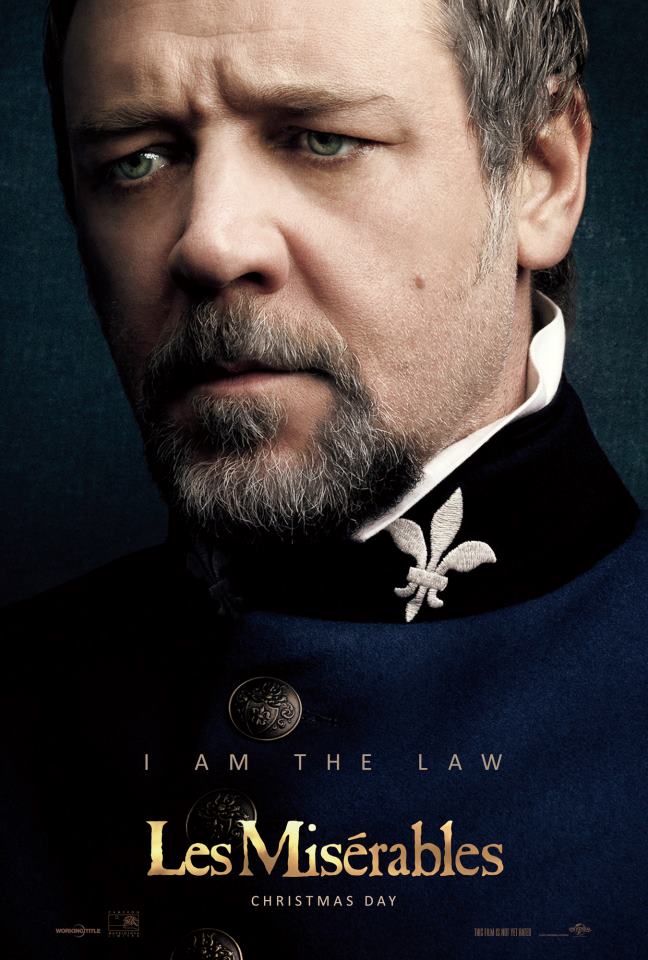
In Defense of Javert

With the recent resurgence of Les Miserables in popular culture, I want to take this opportunity to discuss a fascinating literary character: Inspector Javert.  In one of my very first blog posts, I gave a quick review of Hugo's literary masterpiece and briefly mentioned my connection to Javert.  However, I now want to indulge in further discussion of those feelings.  (You can read my original post here.)

I think that Javert is one of the most misunderstood characters in literature.  He is almost always categorized as a villain and criticized.  (Russell Crowe is likewise receiving criticism for his portrayal of this character, but I'll get to that a bit later.)  The second time I saw Les Miserables on stage, I overheard the man behind me trying to describe Javert at intermission: "He is a despicable human being... scum of the earth."  My heart leapt in objection, and I had to restrain myself from heartily expressing my dissent.

I believe that Javert is Valjean's foil but not the story's villain.  A villain is typically described as "an evil character in the story," but it is almost impossible to argue that Javert is evil.  Although he may have a skewed sense of right and wrong, he relentlessly pursues that which he perceives as good.  A foil, however, is described as "a character who contrasts with another character in order to highlight each other's particular qualities."  Javert and Valjean are certainly set in contrast throughout the novel, but this emphasizes each man's core beliefs and principles.

To really understand Javert, you must read the book.  But because the book is absolutely massive, I will try to fill you in as best as I can to save you some of that work.  Javert is a man of the highest integrity and discipline.  He has dedicated his life to public service and believes that the only way to be just is to be completely unbiased.  Yes, he develops a Captain Ahab-type obsession with Valjean, but it comes from dedication to his job.  In truth, I think all of Hugo's characters are fairly one-dimensional, but that doesn't bother me because of the broad variety of characters and the grand scale of time and action in Les Miserables.  However, Javert experiences arguably the most drastic character development when he encounters Valjean's mercy.

The chapter that describes Javert's suicide is absolutely breath-taking.  In fact, it is the passage of the novel that I remember most clearly and carries the most lasting impact after a few years have passed.  I just read it again after watching the recent movie, and I was just as enthralled by it.  Although there are many brilliant ways in which the musical version of the story captures the essence of the novel, I do not think it adequately represents Javert's suicide.  So allow me to let the book speak for itself:

"Javert's ideal was not to be humane, not to be great, not to be sublime; it was to be irreproachable.  Now he had just failed."

"His supreme anguish was the loss of all certainty.  He felt that he was uprooted.  The code was now but a stump in his hand."

"'In sparing me, what has he done?  His duty?  No.  Something more.  And I, in sparing him in my turn, what have I done?  My duty?  No. Something more.  There is then something more than duty.'  Here he was startled; his balances were disturbed; one of the scales fell into the abyss, the other flew into the sky, and Javert felt no less dismay from the one which was above than from the one which was below."

"All that he had believed was dissipated.  Truths which he had no wish for inexorably besieged him.  he must henceforth be another man.  He suffered the strange pangs of a conscience suddenly operated on for the cataract.  He felt that he was emptied, useless, broken off from his past life, destitute, dissolved."

You see, Javert's torment and subsequent suicide were a picture of deep humility.  Rather than stubbornly refusing to change his mind, he recognized that he had been wrong.  He spent a considerable period of time in deep thought, coming to the humbling conclusion that his strict moral code was imperfect, and he was crushed by this realization.  Javert had not been pursuing evil, and he was anguished by the discovery of his own error.  His death is the loss of a good and upright man, a loss you have to both respect and mourn.

I love Russell Crowe, and I probably always will.  So it's possible that I'm biased about his portrayal of Javert, but I do think it was well done.  No, Crowe doesn't have the best singing voice, but even he would admit that.  However, he brought nobility as well as angst to the role.  His portrayal of the suicide was phenomenal and truly brought to life the images in the book.  Crowe illustrated Javert's conscience and moral anguish rather than making him appear stubborn.  In showing these subtleties, his acting made up for his singing and added depth to the movie.

Thank you for allowing me to explore this fascinating character in detail.  In closing, I want to say that Les Miserables is a beautiful, fabulous, brilliant book.  The musical is a masterful interpretation of the story.  The recent movie is a heart-wrenching and powerful adaptation of the musical.  All three forms of this story are worth your time.

Wednesday, December 19, 2012

Let the Great World Spin

I certainly agree that it is "the most wonderful time of the year," but it also tends to be the busiest.  Lately, updating my blog has not been high on my priorities list, but I always find myself missing it when I've let too much time go by.  The most recent push that is bringing me to write this post is Let the Great World Spin by Colum McCann.  I first read it about a year ago per the suggestion of a good friend, and I just urged one of my other friends to pick up a copy.

For me, one of the immediately remarkable things about this book is that it was written in 2009.  If you have been following my blog, you are probably aware that I am typically at least 60 years behind and often return to pieces from the 19th century.  However, as I have stated before, I do not think books are good only if they are old and labeled "Classics."  There are still great pieces of literature being produced today, though it can be more challenging to filter through them.  I have listed five other works in my Contemporary Series and am happy to now add McCann's book to my list.

Let the Great World Spin is in the form of a series of vignettes and could perhaps be defined as a short story cycle.  It is set in New York City in 1974, centered around one day in which Philippe Petit walked between the Twin Towers on a tightrope, thousands of feet in the air.  This part of the story is a true event, and the story has been documented on film (Man on Wire) and in writing.  However, this tightrope walker is not the protagonist of McCann's book but rather an interweaving theme that peripherally appears in the lives of a variety of New Yorkers on that day.  His daring walk across the high-risers of NYC is symbolic of the emotional precipice so many of us balance in our daily lives.  But the difference with Petit, and what makes him extraordinary to all the observers in the story, is that he leaps and dances his way across.

These characters represent the melting pot of New York City, ranging from prostitutes in South Bronx to housewives on Park Avenue, and everything in between.  Their stories paint a colorful picture of the range of struggles, achievements, heartaches, and motions that can take place on one day in one city.  They remind us that we are all connected, even when we are wrapped up in our individual worlds.  Their stories are both heart-breaking and heart-warming, and they beautifully illustrate the differences even in our shared space within each of our minds, hearts, and lives.

McCann has brilliantly crafted these stories, and some of the connections are so subtle that I had to flip back through past stories to confirm them.  For this reason, I highly advise against reading this book on an e-reader, though I myself am an avid Kindle user.  There are some ways in which an e-reader will never be able to measure up to physical books, and this novel highlights those differences.  I believe your reading experience will be much richer if you continually check back on past stories and piece the vignettes together. By the end of the novel, you will find that they all function in a circle, and to appreciate them individually, you must appreciate them as a whole.

For the New York Times review of Let the Great World Spin, click the image below: