Wednesday, June 29, 2011

Jude the Obscure... I loved it!

I recently read my first Thomas Hardy book, Jude the Obscure, and I’m dying to discuss it.  I think I had entirely the wrong impression about Hardy because I linked him with the other authors I know who were writing in his era.  Yet when I did a little research about it, I learned that this book specifically received negative attention for being so different than the other literature of the time.  It was banned from a number of places, and there’s even a rumor that a bishop publically burned a copy.  Fortunately for Hardy, he was already a successful writer by this time and this was his last novel anyway.
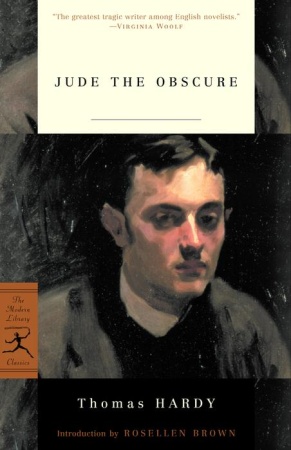
Let me just start by saying I loved it.  I think the themes are fascinating and multi-dimensional, and the characters are so realistic it almost takes the romance right out of it.  So what made Jude the Obscure so different and controversial?  I think the most obvious reason for this reaction is its treatment of marriage.  Hardy unapologetically exposes the non-romantic aspects of marriage that we usually don’t see in literature.  Multiple characters are unhappy in their marriages, and some of them even acquire divorces, which was highly unusual at the time.  In fact, the female lead character, Sue, proposes not only that couples can be in a happy relationship outside of marriage, but also that this is the only way to be truly content in a relationship.  I imagine that this was a very revolutionary idea in 1895 when it was published.  In fact, I think it’s still a little revolutionary today.  I’m not sure I agree with her, but I can see that we still look at marriage as the primary way to demonstrate love and dedication in a relationship.  In a number of ways, Sue is a strong female figure with intellectual and emotional insight, as well as the courage to challenge the culture’s mindset.  However, my admiration for her eventually morphed into pity, but I don’t want to spoil anything for you so I’ll move on.
It’s interesting to me that I read Sons and Lovers and Jude the Obscure back-to-back because I think the character formation is similar.  Jude and Sue are both flawed, although I tend to be very forgiving of Jude.  (I happen to like him way better than Paul Morel).  I should have known that anyone with the title “the Obscure” attached to him would be an appealing character for me, but I was surprised by the way I connected with him. 
One of my absolute favorite things in the novel was Jude’s unbreakable attraction to the academic town of Christminster.  It seemed obvious to me that Christminster was Hardy’s fictional name for Oxford, England, and he portrayed it incredibly well.  I had the wonderful opportunity to live and study in Oxford for a year, and it did not take me two seconds to recognize that this was the town Hardy was subtly describing.  The physical description of the buildings and streets was incredibly heart-warming to me as I remembered my time there.  He so intricately expressed the indelible feeling you get in the city knowing that great academics lived and studied there before you.  But part of what made Hardy’s description so accurate was the snobbery Jude encountered from the academics.  In my experience, there is a very real division between those who live in the city as academics and those who live as blue-collar workers.  The people of “Christminster” did not welcome Jude and his love of knowledge, and Jude eventually discovered the two different worlds that preside in this one historic city.  Even though I was there as an academic, I even sensed some of those boundaries from my fellow students simply because I was American.  Nevertheless, I have an enormous amount of love for the city of Oxford and feel as emotionally tied to it as Jude was. 
But perhaps the gritty realism isn’t in the characters individually but instead in their interaction as a couple.  The struggles and concerns of Jude and Sue throughout their relationship remove the “fantasy” aspect of their love story, and yet this is precisely why I found it to be believable.  They face a number of obstacles, but they work through it together.  And then, shockingly, tragedy strikes and challenges their relationship to the very core.
I was absolutely shocked by this tragic twist near the end.  I honestly did not see it coming at all, although hindsight is 20/20, of course.  In fact, as I was reading in public, I think I noticeably gasped and clasped my hand over my mouth.  (Hmm, I should probably stop reading in public, because I’ve had other noticeable public reactions reading Lord of the Flies, A Hero of Our Time, and Captain Corelli’s Mandolin…)  But seriously, this particular scene in Jude the Obscure really ripped my heart into pieces.  It also completely changed the course of the novel.
I’ve already written so much, so I will stop myself from saying more.  If you have read all this, I am so glad that you took the time.  Clearly, I connected with this novel in a number of different ways, and I hope that this will inspire you to pick up a copy yourself or consider it from a different perspective if you have already read it.  I do have a final question for any readers still looking at this.  If you have read other Hardy novels, do you think that this is similar or considerably different?  I wonder if Jude the Obscure was a bit unusual and I might be surprised in reading Hardy’s more popular works.  Thanks for stopping by!

Thursday, June 16, 2011

Sons and Lovers

I've had some trouble figuring out what I was going to say about Sons and Lovers by D.H. Lawrence.  I read it by the recommendation of friends and fellow book bloggers, but it was not at all what I had in mind.  My earlier impression of Lawrence must be coming from what I've heard of Lady Chatterly's Lover because this was so different.  And when I finished, it took me some time to dissect how I felt about it.  But I did really like it, and I do think it's valuable literature.

Overall, I think there is a lack of excitement in Sons and Lovers.  The plot moves steadily, and there are no significant high moments or thrilling achievements.  I'm not saying it's boring; I'm just saying it's not The Three Musketeers.  Yet I think that the slow pace may have contributed to my uncertain feelings at the end of the novel.  I didn't feel like it was moving toward a dramatic climax, and the one thing that the story seemed to be moving toward wasn't even realized.  (I won't explain this any further to avoid spoiling it for you).  In the nature of the plot, I found that there wasn't even something in particular I was hoping would happen.

However, it didn't take me long to realize the true strength of this novel.  In fact, I was almost startled when it occurred to me because I should have picked up on it right away.  The characters in the story are extraordinarily realistic.  Lawrence so carefully developed each of them that it is hard to believe they are fictional.  Each character of focus has a significant back story to help us understand how he or she become the person in the story.  For example, by learning all about Mrs. Morel's ambitions and desires, we see how her marriage became a bitter disappointment.  This also helps us to understand why she began to live through her children.  And yet it's not so simple as an unhappy marriage.  In a delicate way, Lawrence weaves in an underlying and reluctant love between man and wife.  They fight and they put each other down, but they are bonded in an inseparable way until the very end.

I thought William was going to be the protagonist and was surprised when the focus shifted to Paul.  And somehow, by carefully crafting the personal and emotional details of William, we are prepared for an even deeper understanding of Paul.  As for Paul, he is a tormented character, and I was frustrated with him for most of the story.  However, I could thoroughly understand his actions even when I didn't agree with them.  Even Miriam and Clara, Paul's two loves, have a significant amount of depth to them.  They are very different women, and their respective attraction to Paul comes from unique needs and desires.  Naturally, this adds dimension to the relationships he has with each of them.  There is just nothing silly or frivolous in this novel.  All of the characters are flawed and yet so very real.  It feels so profoundly human that I began to view the characters in a different way than I usually do for fictional people.  I think I was processing their motives and feelings on a deeper level because they themselves have so much depth.

Despite the remarkable realism in the characters, Lawrence somehow achieves this subtly.  He is not imposing the background stories on the readers or forcing us to attach ourselves to them.  In fact, in my opinion, there's not a single character we are meant to really love.  There are no heroes, and yet this is the genius of it.

Although I enjoyed it, I don't think I'll be rereading Sons and Lovers.  The characterizations are not enough for me to go back repeatedly to the text the way an exciting plot might pull me in again.  I read somewhere that this is Lawrence's most autobiographical work, which is probably how he managed to create such realistic characters.  So I have a feeling his other works may be more exciting, and I will read them at some point.  But for now, I just want to rest in admiration of how truly human these characters seemed to be.  What do you think of the novel?  Was this similar to your experience?

Friday, May 27, 2011

Passing

As I write this post I realize that I have only blogged about one female African American author, and I don't think that's sufficient.  I want to consciously review diverse and interesting literature just as I want to read a variety of work.  And please, don't hesitate to recommend authors of backgrounds and nationalities that I have so far overlooked.  So today I want to talk a little bit about Passing by Nella Larsen.

In my opinion, Passing is one of the somewhat hidden gems of the Harlem Renaissance.  The protagonist of this story is a fair skinned, African American woman named Irene.  Her foil is the equally important Clare, who also has light skin.  Both of these women have discovered that because of their light skin tone, they can actually "pass" as white.  Irene takes advantage of this from time to time, but Clare has made a decision to permanently present herself this way, even marrying a racist white man and hiding the truth completely.  When these women reunite at a chance encounter, their lives are torn in the comparisons they make.  Irene is swept up in Clare's glamor, and Clare discovers an intense longing to reconnect with her people.

Irene is precisely the kind of character who fascinates me in fiction.  I have followed a number of characters who struggle with their identities, but Irene's internal division is so powerful that it is represented externally as well.  She can literally choose how she wants to present herself - as a black woman or a white woman - and it shapes the way others interact with her.  The presence of Clare brings an enormous amount of insecurity to Irene, as she questions her own physical and emotional value.  With time, Irene's life revolves almost completely around the various pretending she does, which is not limited to pretending to be white in restaurants.  Instead, she must constantly pretend that she likes Clare as a friend and that her marriage is healthy and stable.  Her marriage is likewise a source of great stress and pain, as it crumbles into a detached coldness.  Unable to reconcile the various definitions of herself, Irene is likewise unable to connect to her husband, and the emotional distance between them becomes increasingly great.

In the second half of the novel, things spin rapidly out of control.  By the end, Irene is so frazzled that she falls into great, self-destructive tragedy.  When I first finished reading this, I explored the idea that perhaps Irene had developed Delusional Disorder, as the division she created in her life tore so deeply that it penetrated her mind.  I theorized that the things she believed were happening might actually have a logical explanation from someone else's perspective.  This is cerainly not a view that scholars have yet adopted, but I found it to be an intersting interpretation.  Regardless of the validity of this idea, the key themes of the story are issues concerning one's foundation of self as an African American and as a woman.

I read some bloggers who felt that some of the poignancy of the story has faded since people don't try to pass as white anymore.  As a white woman myself, I am certainly not the best person to make a statement about this, but I do want to share some of my thoughhts.  I have heard some African American friends be accused of "acting white" because they are invested in academics or participate in certain social activities.  It bothers me that academic and similar success is still often equated with whiteness.  I think it's important to cherish unique aspects of indvidual culture, but it becomes a problem if it creates significant obstacles for a person striving to live his or her best life.  I guess I just want to encourage people to stay conscious of the barriers we still put up among races, even though they are taking different forms.  Ok, I'll step off my soap box now, but I would be interested to hear your thoughts about any of this if you would like to share.

Monday, May 23, 2011

Oblomov, another Russian

Since my last post was about the fun and popular Great Gatsby, I am allowing myself to talk about an obscure Russian book again.  Please forgive me if this is starting to drive you crazy, but I do believe that some of you may find these books genuinely interesting and worth your time.  I really am not trying to sound pretentious and academic; I just happen to have acquired an affinity for Russian literature.  This time, I want to talk about Oblomov by Ivan Goncharov.  It's actually fairly difficult to find a good review of this book online, but maybe I can offer a decent one for you.

Although many native English-speakers are unfamiliar with this novel, it is quite embedded in Russian culture.  For example, it inspired the word "oblomovshchina," which means something along the lines of "lazy, lethargic, and listless."  It was a very popular book in Russia in its day, which was around the 1860s, a booming literary era in Russian history with extraordinary contemporaries like Dostoevsky and Tolstoy.

In so many ways, I think that Oblomov embodies everything about the quintessential Russian style.  First of all, the story is written from the perspective of a narrator who does not exist in the story and yet nevertheless breaks in to offer his opinions now and then.  I love this style because the narrator can "objectively" retell the story, but his scattered commentary is humorous and adds to the content.  Similarly, much of the interaction between Oblomov and his servant Zakhar is funny and ironic.

If there were ever a character who displayed the potentially existential depression of listlessness, the "superfluous man" if you will, he is Ilya Ilyitch Oblomov.  His story, very simply, is that of a man who cannot seem to get off the couch.  It is not that he is physically restricted to the couch, but that he lacks the desire and motivation to get up and take action in his life.  From the very beginning, we learn that there is noticeably an "absence of any definite idea" as well as a "total lack of concentration" in his countenance.  Throughout the story, Oblomov frequently decides that he ought to get up, but somehow he never seems to be able to do it.

Despite the restriction to the couch, Goncharov is able to keep the story moving.  Part of this comes from a number of visitors who stop by and talk to Oblomov.  We also learn a lot about Oblomov's past, which helps us understand how he got in this situation.  An interesting dynamic of the novel is his relationship with the two prominent women in his life - Olga, his former flame, and Agafya, the landlady he marries.  They represent the two natures within him, as well as the one which conquers.

I don't want to talk about the plot much more because I think it is the language that makes the novel so wonderful.  It's not so much about what happens but about how the story is told.  There are a number of interesting themes to consider, to be sure, and anyone who is intrigued by the superfluous man would enjoy this character.  But I particularly love the book for the narration itself.

Because Oblomov reviews are somewhat hard to find, I want to include an excellent link that provides much more information about the book if you wish:  http://www.powells.com/review/2007_01_25.html

Thursday, May 19, 2011

The Great Gatsby

I am eager to get back to blogging, and I figured there would be no better way to restart than with F. Scott Fitzgerald's beloved classic, The Great Gatsby.  There are few people who are not familiar with this text, and I think people commonly enjoy it.  It's very different than some of the more serious books I've discussed, but I think variety is important on any great book list, and I don't want to neglect Gatsby just because it's fun.

As it's been quite a long time since I actually read the book, the main aspect of it that stands out in my memory is, of course, the lavish "Roaring 20s" parties.  I remember talking about this on one of the blog hops, and a lot of people shared my desire to crash one of those fabulous Gatsby parties.  However, I think this is probably a somewhat unfair memory because of all the devastation at the end of the story.  Somehow, I sincerely doubt that Fitzgerald was hoping his readers would walk away from the book with feelings of envy.

I think it's interesting that Fitzgerald included destruction and depression in this portrait of the 1920s.  I have a feeling that people living in the 1940s, and even today, might have a tendency to idealize the "Roaring 20s" after living through the Great Depression and World World II.  Yet Fitzgerald was able to recognize the superficialities and problems of the 1920s even while he was living in them.  Although the characters were blessed with decadence and celebration, they lacked fully formed identities and stumbled through the plot in various ways to gain superficial confidence.  Despite his outwardly suave appearance, Gatsby is desperate for Daisy's affirmation.  Deep down, he's just an insecure, lovesick boy who builds an idealistic dream.  When he is forced to confront the reality of his dream, he is left feeling lost and confused.  Likewise, Tom cannot imagine an existence in which his wife doesn't adore him, even though he has acted out in a number of affairs.  Daisy is a difficult character to admire, for we see her as shallow and insincere.  She doesn't live up to be a great literary heroine, with moving emotions and admirable actions.  We are never shown a deeper, more intimate side of her, and we struggle to believe that she deserves the devout admiration of both Gatsby and Tom.  

Nick is our most stable character, who is able to see the grim truth behind the opulence he encounters.  He leaves his hometown to seek out a more desirable life but in the end decides to return contentedly to the Midwest.  I think Fitzgerald uses him as a guide for readers who might be inclined to wish for extravagance to instead appreciate their practical lifestyles.  Even though he doesn't accomplish some herculean task or save the day with an impressive insight, he is our hero for successfully avoiding the muck of extravagance.

There are also a number of symbols in the book, along with some intriguing characters like the "owl-eyed" man.  I know that I really enjoyed reading the book, and I think it was written very well.  I like that Fitzgerald gives us an Oz-like "view behind the curtain" of the marvelous 20s, and I think it can confidently rest among the shelves of other great literature.  But I'm curious to hear from any of you what it is that you like (or don't like) about the book.  What are some of the meaningful messages you think Fitzgerald presents?  Or, perhaps, do you think the book is overrated?

Monday, April 11, 2011

A Hero of Our Time

First of all, I need to give a big shout out to Ingrid of The Blue Bookcase.  Way back near the beginning of my blog, I made a list of great Russian authors of the 19th Century.  Ingrid noticed that I did not mention Mikhail Lermontov, so I added him to my lengthy "To Read" list and picked up a copy of A Hero of Our Time at a used bookstore.  Little did I know that I had a magnificent Russian treasure sitting on my shelves, which I absolutely devoured once I opened its pages.  So Ingrid, thank you for the suggestion!  This is exactly why I love the book blogging world, and I hope any of you who may read my blog can likewise send recommendations my way!

To quickly summarize, A Hero of Our Time can be divided into two parts.  In the first part, the narrator listens to a third party, (Maxim), talk about his experience with the protagonist, Pechorin.  In short, Maxim tells the narrator how Pechorin kidnapped a young girl for a bit of fun, enjoyed the challenge of winning her affection, and then promptly lost interest in her.  Then, the narrator has a brief encounter with Pechorin himself and offers a direct description of him.  In the second half of the novel, the narrator has turned over Pechorin's personal journal, and we read about three of his experiences.  Now we get an inside perspective of Pechorin, which reveals a largely depressed man who is utterly listless about life.

A Hero of Our Time is delightfully Russian.  Lermontov writes in the typical Russian-style narration, in which the narrator frequently interjects in his story with humor, irony, and ample commentary.  Even as I sat in public, I couldn't help but chuckle at some of the narrator's comments as he directly addresses his readers.  Of course, this only occurs in the beginning of the novel before we reach Pechorin's journals.  (If you're curious, Gogol, Goncharov, and Turgenev all write in a similar fashion.)

Another prominently Russian feature of the text is the subject of the "superfluous" hero.  Pechorin is a young, handsome, and wealthy citizen who has tired of the various social engagements and romantic flings he encounters and succumbed to the dreaded ennui.  He's bored.  Repeatedly in his diary, Pechorin laments his lack of feelings and his inability to get excited about things in life.  Many Russian characters display similar problems, and it seems that Lermontov was the first author to create a protagonist like this.  However, I think that Pechorin has many more layers than this.  He frequently contradicts himself, particularly whenever he interacts with his former flame, Vera.  I think these various interactions are really important for understanding the character.  In another contradiction, Pechorin claims that he enjoys having enemies because it makes life more interesting.  However, when he overhears people talking about him negatively, he is shocked and hurt by their remarks.

I liked A Hero of Our Time because it's written well, with an intriguing design to the story and an interesting and multi-dimensional main character.  If this weren't enough, the novel's even more remarkable for its innovation.  Lermontov was one of the leaders of the flourishing 19th century in Russian literature, greatly influencing those who followed him.

Thursday, April 7, 2011

As I Lay Dying

I find it a little hard to believe that I've come this far along and have yet to discuss William Faulkner.  I whole-heartedly include Faulkner in any list of brilliant authors, and he is often picked out as one of the best American authors of all time.  In fact, I had the opportunity to attend a short lecture series on American literature while I was in England, and the professor focused primarily on Faulkner.  And if you have a sense of my taste in literature so far, you will not be surprised to hear that I find his dark material irresistibly fascinating.

As I Lay Dying is the first Faulkner novel I ever read.  This was also my first exposure to stream of consciousness in writing, although I didn't know it by that term yet.  Each chapter is written from the perspective of a different character, and their myriad writing styles reflect the dramatic differences between them.  The story follows the eccentric and dysfunctional Bundren family as they carry their dead mother's body in a wagon pulled by mules across a number of towns in the south to bury her in Jefferson.  The story is bursting with dark humor and biting satire, as they experience a series of misadventures that hardly honor the dead.  Yet behind the quirkiness, Faulkner compels readers to reflect on the significance of death, the relativity of sanity, and the meaning of family.

Without question, my favorite thing about this novel is the diversity of characters.  I love the way he takes turns unveiling their perspectives, such as little Vardaman associating his mother's death with killing a fish.  There are fifteen different narrators in all, and even Addie, the dead mother, gets a chance to speak beyond the grave on a chapter.  The most frequent narrator is Darl, whom I find to be the most fascinating character.  For much of the novel, he appears to be the most sane and level-headed of the siblings.  It is easy to notice the father's faults, Cash's obstinateness, and Dewey's selfishness.  Darl, on the other hand, assumes a leadership position among his siblings.  At the same time, he demonstrates a level of sensitivity that the others seem to lack.  Moreover, because the rest of the family speaks with improper grammar and elementary descriptions, Darl's elegant prose and intellect convince readers of his superiority and reliability.  However, as the novel progresses, our perspective of Darl spirals out of control as we eventually realize that he may actually be the least sane of them all.

As I Lay Dying is stylistically innovative, insightfully astute, and generally entertaining.  Faulkner masterfully balances humor with social critique, making this both a fun and stimulating novel.  He also pioneers the stream of consciousness movement, inviting us into the radically diverse minds of fifteen different characters.  I highly recommend it to everyone and happily stick it in my "Classical Literature" shelf.